Leasing AI Implementation Roadmap: 2026 Guide & Timeline
Use the Leasing AI Implementation Roadmap to plan a compliant 6-phase rollout with KPIs and fair housing safeguards. Scale results in 90 days.

TL;DR
A leasing AI implementation roadmap is a phased plan for adopting AI-powered leasing tools across your portfolio, covering everything from workflow audits to portfolio-wide scaling. Most property management teams see initial benefits within 30 to 60 days, with full capability utilization around 90 days. This guide organizes every key term and milestone by implementation phase so you can move from assessment to optimization without blowing up your current operations or running into fair housing trouble.
Property management professionals spend 66% of their time on operational tasks rather than strategic work, according to the AppFolio/NAA 2025 Performance Ecosystem Report. A well-structured leasing AI implementation roadmap exists to change that ratio, but only if each phase is executed in the right order.
2026 marks a turning point. AI usage among property managers jumped from 21% in 2024 to 34% in 2025, and over 99% of multifamily operators are now implementing or planning to implement AI solutions. Yet 78% of survey respondents say they cannot yet rely on the AI features in their legacy property management software. The gap between intent and execution is enormous.
This guide breaks down every term, metric, and concept you will encounter across six implementation phases. It is not organized alphabetically. It follows the sequence you will actually experience, from initial assessment through portfolio-wide scaling.
Compare leading leasing AI vendors to see where different tools fit into this roadmap.
Direct Answer: What Is a Leasing AI Implementation Roadmap?
A leasing AI implementation roadmap is a step-by-step plan for deploying AI leasing tools across a multifamily portfolio. Most implementations follow six phases:
- Assessment and readiness
- Vendor selection and pilot testing
- PMS integration and go-live
- Fair housing compliance management
- KPI measurement and optimization
- Portfolio-wide scaling
Most operators begin seeing measurable improvements within 30 to 60 days, while full AI adoption maturity typically occurs within 90 days. The primary goals are faster response times, higher lead-to-lease conversion rates, reduced manual workload, and improved operational consistency across leasing teams.
Typical Leasing AI Implementation Timeline
Phase | Goal | Estimated Timeline |
|---|---|---|
Assessment | Audit workflows and systems | Weeks 1–2 |
Vendor Selection | Run proof of concept and pilot | Weeks 3–4 |
Integration | Connect PMS and train staff | Weeks 5–12 |
Compliance | Monitor fair housing risks | Ongoing |
Optimization | Improve KPIs and QA accuracy | Weeks 8–16 |
Scaling | Expand across portfolio | Week 17+ |
Why Most Leasing AI Implementations Fail

Most leasing AI deployments fail for one of four reasons:
No baseline metrics before launch
Poor PMS integration quality
Weak staff adoption and training
Inadequate fair housing QA processes
Many operators rush directly into automation without validating workflows first. Others remain stuck in “pilot purgatory,” where the AI works technically but never scales across the portfolio because no success thresholds were defined.
The most successful implementations share three traits:
Clear Operational Goals
Teams define exactly what the AI should improve before deployment, including:
Response times
Tour scheduling efficiency
Lead qualification
Leasing conversion rates
Staff workload reduction
Strong Human-AI Workflows
AI performs repetitive operational tasks while human agents handle:
Complex objections
Compliance-sensitive conversations
Relationship building
Lease negotiation
Escalations
Continuous QA Monitoring
High-performing operators continuously:
Audit AI conversations
Test edge-case responses
Monitor incorrect answer rates
Review fair housing compliance
Optimize qualification logic
Roadmap Overview: Phase-by-Phase Timeline
Before getting into definitions, here is the approximate timeline based on consolidated industry benchmarks:
Phase | Focus | Typical Duration |
|---|---|---|
Phase 1: Assessment & Readiness | Workflow audit, baseline metrics, tech stack review | Weeks 1–2 |
Phase 2: Vendor Selection & Pilot Design | Proof of concept, vendor evaluation, pilot criteria | Weeks 3–4 |
Phase 3: Integration & Go-Live | PMS integration, staff training, phased rollout | Weeks 5–12 |
Phase 4: Compliance & Risk | Fair housing audit, AI usage policy, vendor agreements | Ongoing from Week 1 |
Phase 5: Measurement & Optimization | KPI tracking, QA testing, conversion analysis | Weeks 8–16 |
Phase 6: Scaling & Future-Proofing | Multi-property rollout, stack expansion, agentic AI | Week 17+ |
Most property management companies see initial benefits within 30 to 60 days. Full AI capability utilization typically occurs within 90 days as the system learns your specific patterns and preferences.
Phase 1: Assessment and Readiness
This is the diagnostic phase. Everything you do here determines whether the rest of your leasing AI implementation roadmap produces results or creates expensive headaches.
Workflow Audit
A workflow audit maps your current leasing processes, from inquiry intake and tour scheduling to follow-up and application, to identify exactly where AI adds the most value. Successful operators start by assessing operational bottlenecks and identifying workflows that consume the most staff time or produce the most friction for prospects.
Why it matters: Without a clear picture of your current workflows, you cannot tell whether AI is solving a real problem or just adding a new layer of complexity. The most common mistake is skipping this step and deploying AI on a workflow that was not broken in the first place.
Tech Stack Assessment
This means reviewing your existing PMS, CRM, listing syndication tools, showing schedulers, screening services, lease generation software, and communication platforms to identify integration points and gaps. Property managers typically juggle five or more tools in their leasing stack, and a new AI tool needs to connect with most of them.
Why it matters: The most effective AI tools offer deep, two-way synchronization with your existing systems of record. If your PMS cannot push data to the AI (or receive data back), you will end up with a glorified chatbot that creates more manual work than it eliminates.
For a broader look at how all your tools fit together, read about building your AI property management stack.
Baseline Metrics
Baseline metrics are the KPIs you record before AI deployment so you can measure impact afterward. Key baselines include lead-to-lease conversion rate, average response time to inquiries, tour show rate, time-to-lease, and cost-per-lease. Track time saved, errors reduced, and revenue protected. Establish these benchmarks before implementation so you can demonstrate ROI.
Common mistake: Many teams skip baselining because it feels tedious. Then, three months into deployment, they cannot prove whether the AI helped or not, which makes the case for scaling (or continued investment) nearly impossible to argue.
PMS Integration
PMS integration is the connection between your AI leasing tools and your property management system (AppFolio, Yardi, RealPage, or others). This connection allows the AI to pull real-time unit availability, pricing, and property details, and to push actions like tour bookings and lead notes back into your system of record.
Why it matters for the roadmap: Integration quality determines whether your AI can take real actions or merely generate text. A two-way sync is the difference between an AI that books a tour and updates the calendar and one that tells the prospect to call the office.
Phase 2: Vendor Selection and Pilot Design
Phase 2 of the leasing AI implementation roadmap is where you stop researching and start testing. The goal is to narrow your options, design a controlled experiment, and build internal confidence before committing budget to a full rollout.
Proof of Concept (PoC)
A proof of concept is a limited-scope test of an AI tool on a single workflow or a single property to validate that it works before you commit broader resources. Implementation typically begins with a PoC for a specific use case, such as after-hours inquiry response or automated tour scheduling.
Why it matters: A PoC answers one question: “Does this tool actually do what the vendor claims?” Start with a single high-friction workflow to build internal confidence before scaling. The common failure is skipping the PoC and going straight to a multi-property pilot, which makes troubleshooting much harder.
Pilot Program
A pilot program is a controlled deployment on two to three properties over 30 to 60 days with clearly defined success criteria. During the pilot, you should mystery-shop the AI with real edge-case inquiries, track all the baseline metrics you established in Phase 1, and gather qualitative feedback from on-site leasing staff.
Why it matters: The pilot separates tools that work in demos from tools that work in production. One practical tip from Leasey.AI: over-automating initial touchpoints without prompt human follow-up can reduce showing-to-application ratios and later impact renewal rates and tenant quality metrics. A/B testing automated versus human-first follow-up during the pilot is a concrete way to catch this early.
AI Leasing Assistant
An AI leasing assistant is a conversational agent that handles renter inquiries, schedules tours, and automates follow-ups across webchat, SMS, email, and voice. It enables round-the-clock engagement and preliminary lead qualification, which are the two things leasing teams struggle to deliver consistently with human staff alone.
Conversational AI vs. Chatbot
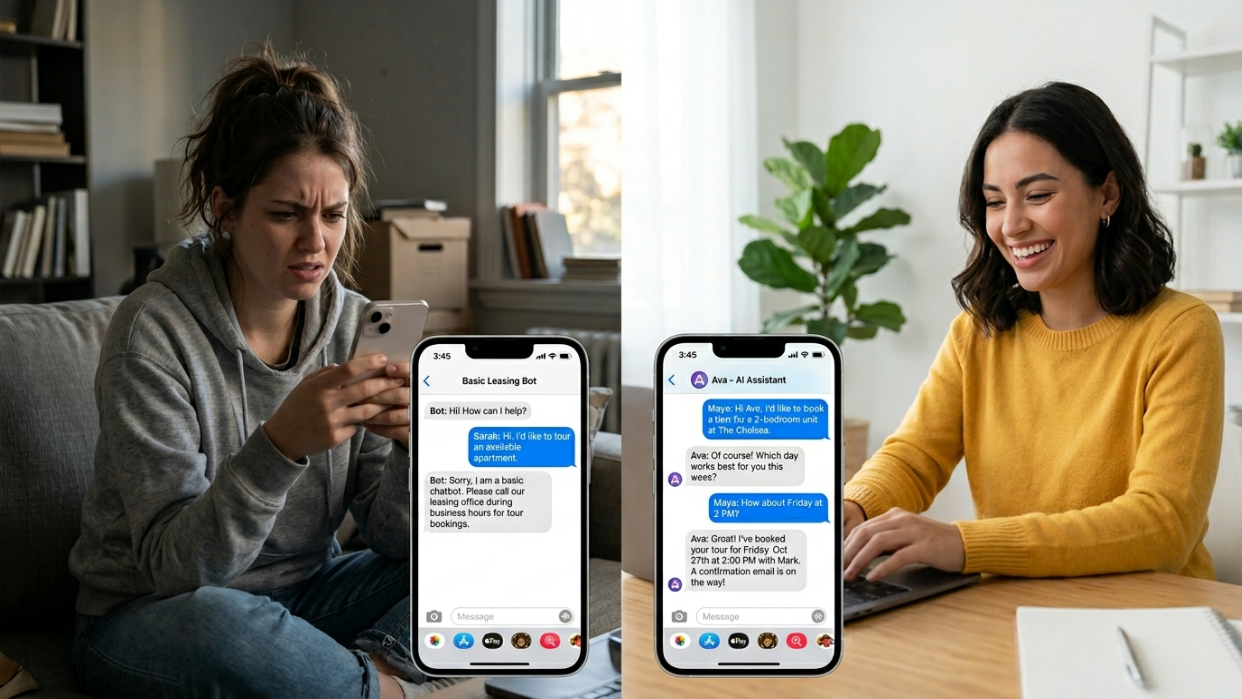
This distinction trips up a lot of buyers. A basic chatbot follows a decision tree: if the prospect asks X, respond with Y. Conversational AI is different. The best virtual leasing agents integrate with property management systems to provide accurate, real-time availability and pricing. They schedule tours directly into calendars and hand off qualified leads to human agents with full conversation context.
Why it matters: If a vendor calls their product “conversational AI” but it cannot pull live pricing from your PMS or book a tour without human intervention, it is a chatbot with better marketing. For a deeper look at how voice-based systems handle this, read about how voice AI for leasing calls works.
Chatbot vs Conversational Leasing AI
Capability | Traditional Chatbot | Conversational Leasing AI |
|---|---|---|
Uses scripted responses | Yes | No |
Understands natural language | Limited | Yes |
Pulls live PMS data | Rarely | Yes |
Schedules tours automatically | Sometimes | Yes |
Handles SMS, voice, email, chat | Usually limited | Omnichannel |
Learns from interactions | No | Yes |
Supports lead qualification | Basic | Advanced |
Provides conversation history | Limited | Full continuity |
Human handoff context | Weak | Strong |
Fair housing QA capabilities | Minimal | Advanced monitoring |
Omnichannel Lead Capture
Omnichannel lead capture means handling prospect inquiries across phone, SMS, email, webchat, and listing sites (Zillow, Apartments.com) from a single AI system. Fragmented communication is one of the top pain points for leasing teams, and prospects expect responses regardless of which channel they use.
Why it matters: If your AI only covers webchat but 40% of your leads come in by phone, you have not solved the problem. A true omnichannel system eliminates the gaps between channels.
Mystery Shopping and QA Testing
Mystery shopping means testing your AI by sending it real-world edge-case inquiries to evaluate accuracy, tone, and compliance. This should happen before go-live, during the pilot, and on an ongoing basis after deployment.
Common mistake: Only testing the happy path. Your AI needs to handle questions about pet policies, accessibility accommodations, income requirements, and Housing Choice Vouchers without stumbling into compliance violations (more on this in Phase 4).
Phase 3: Integration and Go-Live
This is where the leasing AI implementation roadmap gets operationally intense. You are connecting systems, training staff, and going live with real prospects.
Phased Rollout
A phased rollout means launching AI on a subset of properties first and expanding based on results. Successful implementations follow structured approaches: system assessment, pilot testing, staff training, and staged expansion. You do not flip a switch across 50 properties on the same day.
Why it matters: A phased rollout lets you catch problems while the blast radius is small. If the AI is quoting wrong rents at one property, that is fixable. If it is quoting wrong rents at 50 properties for a week, that is a reputation crisis.
Parallel Systems
During the transition, property management teams maintain operations by running parallel systems. Legacy tools stay active while staff learn the new platform with low-stakes tasks. This means your old leasing workflow and the new AI-assisted workflow coexist for a period.
Why it matters: Going cold turkey on your existing process creates unnecessary risk. Parallel systems give your team a safety net while they build familiarity. The learning curve for basic leasing functions typically runs two to four weeks, with advanced features like AI-powered lead qualification taking two to three months to master.
Change Management
Change management is the organizational work required to get your team to actually adopt the new tools. It includes training programs, clear communication about what is changing and why, and ongoing support. This is often the difference between a tool that gets used and a tool that gets resented.
Why it matters: Property management teams are busy and often skeptical of new technology. Without change management, staff will find workarounds that bypass the AI entirely. For guidance on when AI should handle tasks versus when humans should, see the AI leasing agent vs. human playbook.
Human-AI Handoff
The human-AI handoff is the moment when AI transfers a qualified prospect (along with full conversation history and recommended next steps) to a human leasing agent. This means the human starts with context and a higher probability of closing.
Why it matters: A poorly designed handoff creates frustration. The prospect has to repeat everything they already told the AI, and the leasing agent has no context. Define clear triggers for when the AI escalates: budget mismatches, accommodation requests, complex questions about lease terms, or situations where the prospect explicitly asks for a human.
Lead Qualification
Lead qualification is the process of the AI collecting key details (move-in date, budget, pet ownership, unit preferences) to determine if a prospect is a fit before routing to staff. This saves leasing agents from spending time on prospects who are not ready, not qualified, or not serious.
Tour Scheduling Automation
AI tour scheduling books tours directly into calendars based on real-time property availability. This removes the back-and-forth scheduling friction that kills momentum between inquiry and visit. When tied to your PMS, the AI can confirm availability in real time and send confirmation messages automatically.
Staff Training and Adoption Checklist
Technology adoption is often a bigger challenge than the software itself. Leasing teams need clear expectations around how AI fits into their daily workflow.
Leasing AI Staff Training Checklist
Train staff on AI escalation procedures
Define when humans should intervene
Review fair housing compliance workflows
Practice human-AI handoff scenarios
Train teams on QA reporting procedures
Explain KPI expectations post-launch
Establish fallback workflows during outages
Provide ongoing refresher training
Recommended Adoption Timeline
Week | Staff Focus |
|---|---|
Week 1 | Basic AI workflows |
Week 2 | Human-AI collaboration |
Week 3 | Escalation handling |
Week 4 | KPI optimization and QA |
Phase 4: Compliance and Risk
Compliance is not a phase you complete and move on from. It runs parallel to every other stage of the leasing AI implementation roadmap, from vendor selection through scaling.
Fair Housing Compliance
Every AI vendor will tell you their system is compliant. What they usually mean is that they have injected a compliance instruction into the system prompt. That is not compliance. It is a wishful instruction to a probabilistic engine. Large language models generate responses based on statistical patterns, not legal reasoning.
In 2023, a private fair housing nonprofit sued Harbor Group Management after its AI leasing chatbot was found to systematically screen out Housing Choice Voucher holders. This is not a hypothetical risk.
The cautionary example that should concern every operator comes from Jinbo Chen, founder of Valis Residential, who described it in Multifamily Dive in April 2026: an AI that responds instantly about a balcony view but triggers a safety fallback for wheelchair accessibility questions, telling the prospect “a leasing agent will be in touch Monday morning,” creates a documented, two-tiered service system. In the eyes of fair housing law, this is not a technical glitch.
For a comprehensive breakdown, read the leasing AI and Fair Housing compliance glossary.
AI Audit Trail
An AI audit trail is the complete transcript of every interaction the AI has with prospects. These transcripts serve as discoverable evidence in fair housing investigations. Private nonprofit fair housing organizations processed 74% of all housing discrimination complaints in 2024 (versus HUD’s 4.85%), and these organizations now have AI monitoring tools that can test a property’s leasing chatbot remotely, anonymously, and at scale.
Why it matters: Your AI keeps a record of everything. Fair housing testers are using that same transparency against you if the AI behaves inconsistently.
Vendor Compliance Agreement
Agreements governing AI-driven leasing tools should address fair housing compliance explicitly and in operational terms. This includes requirements for transparency, audit rights, prompt correction of inaccuracies, and responsibility allocation for compliance failures. As the law firm Spencer Fane noted in February 2026, providers should assume that regulators and investigators will view AI vendors as extensions of the leasing function rather than independent actors. You cannot outsource compliance responsibility to your vendor.
Disparate Impact and Two-Tiered Service
Disparate impact occurs when AI provides different quality or speed of service based on inquiry type, inadvertently disadvantaging protected classes. The Valis Residential example above is a textbook case. Disability discrimination accounted for 54.59% of all fair housing complaints in 2024, making this the single largest category of risk.
AI Usage Policy
An AI usage policy is an internal document that governs how your team uses AI tools. The core principle: AI is intended to supplement your work, not replace your judgment. Use AI within the context of all existing policies, laws, and regulations. Create, distribute, and enforce this policy across your organization.
Compliance Checklist:
Audit AI transcripts monthly for inconsistent responses
Test the AI with protected-class inquiries (accessibility, voucher holders, familial status)
Confirm vendor compliance clauses in your contract
Train staff on fair housing obligations specific to AI-assisted leasing
Document your QA process in case of investigation
Phase 5: Measurement and Optimization
This is where the leasing AI implementation roadmap proves its value. Without measurement, you are flying blind. With the wrong metrics, you will optimize for the wrong outcomes.
Quick-Reference KPI Table
Metric | What It Measures | Pre-AI Benchmark to Establish | What AI Should Improve |
|---|---|---|---|
Lead-to-Lease Conversion Rate | First contact to signed lease | Varies (industry avg. ~10-15%) | 56% of PMs report moderate uplift; 30% report significant increases |
Response Time | Seconds/minutes from inquiry to first response | Often 4+ hours for after-hours leads | Should drop to under 60 seconds |
Tour Show Rate | % of scheduled tours where prospect shows up | Typically 50-60% | Should increase through better qualification |
Qualified Tour Rate | % of tours where prospect meets basic criteria | Often not tracked | Must be tracked to avoid wasted staff time |
Time-to-Lease | Days from listing vacancy to signing lease | Portfolio-specific | AI should compress by reducing response gaps |
Incorrect Answer Rate | % of AI responses with wrong info | N/A pre-AI | Should trend toward zero with ongoing QA |
Cost-per-Lease | (Marketing + staff + AI subscription) / leases signed | Portfolio-specific | Target 20-30% reduction |
For detailed ROI calculation frameworks, see the leasing AI ROI formula and benchmarks guide.
Lead-to-Lease Conversion Rate
Lead-to-lease covers the full lifecycle from first contact to signed lease. It is measured by conversion rate and time-to-lease. Optimizing this flow reduces vacancies and wasted marketing spend. Industry data from EliseAI shows that 56% of surveyed property managers saw moderate lead-to-lease uplift with AI, while 30% reported significant increases.
Response Time
Response time measures the seconds or minutes between a prospect’s inquiry and the AI’s first response. This is often the single highest-impact metric AI improves. Most human leasing teams cannot respond to after-hours inquiries at all, which means leads that arrive at 9 PM sit untouched until 9 AM. AI eliminates that gap entirely.
For strategies on faster lead follow-up, see the dedicated guide.
Tour Show Rate and Qualified Tour Rate
Tour show rate is the percentage of scheduled tours where the prospect actually shows up. Qualified tour rate is the proportion of tours booked where the prospect meets basic qualification criteria. These two metrics need to be tracked together.
Practitioners on Reddit have shared a revealing case with AppFolio’s LISA feature: guest-card-to-tour conversion increased by about 5%, but tour closing ratio dropped by nearly 10%. The bot booked tours without enough qualification, so staff spent time on prospects who likely should not have toured. This is the danger of optimizing for tour volume without tracking tour quality.
Incorrect Answer Rate
This tracks how often the AI gives wrong information about pricing, availability, policies, or amenities. It must be tracked during QA and after go-live. An AI that confidently quotes last month’s pricing or says a unit is available when it has already been leased destroys prospect trust faster than a slow human response ever would.
Portfolio-Level Analytics
Aggregated data across your properties highlights top-performing locations and trends so managers can scale successful strategies across portfolios. Once AI is deployed on multiple properties, portfolio-level analytics become the primary tool for identifying which properties need attention and which configurations are working best.
Phase 6: Scaling and Future-Proofing
The final phase of the leasing AI implementation roadmap is about expanding what works and preparing for what is coming next.
Multi-Property Templating
Centralized templates for conversation flows, pricing structures, and amenity descriptions enable brand consistency with property-specific customization. This is how you scale from three pilot properties to 30 or 300 without rebuilding configurations each time.
Conversation Memory and Continuity
Conversation memory means the AI recalls prior interactions with a prospect across sessions and channels. If a prospect called last Tuesday, texted on Thursday, and emails today, the AI should know the full history. This avoids repetitive questions and builds trust. It also means handoffs to human agents include complete context.
AI Stack Expansion
AI stack expansion is the process of adding AI agents beyond leasing (maintenance, collections, vendor management) once your leasing AI is stable. This is how operators achieve compounding ROI. One major property group reported a 33% increase in conversion rates after deploying AI-driven leasing automation, and organizations using AI in property management have reported 20-30% improvement in overall operational efficiency. The gains multiply when AI covers more than one function.
Agentic AI
Agentic AI refers to next-generation systems that take initiative and make context-aware decisions beyond scripted responses. Rather than waiting for a prospect to ask a question, agentic AI might proactively follow up with a lead who viewed a listing but did not inquire, or automatically adjust tour availability based on leasing velocity. This is where the industry is heading, and your roadmap should account for it.
Leasing AI Implementation Cost Considerations
Implementation costs vary significantly depending on portfolio size, integration complexity, and communication channels supported.
Typical Leasing AI Cost Factors
Cost Category | Typical Consideration |
|---|---|
Software subscription | Per unit or per property |
PMS integration | One-time setup fees |
Voice AI usage | Usage-based pricing |
Staff training | Internal operational cost |
QA monitoring | Ongoing compliance reviews |
Custom workflows | Additional configuration cost |
Hidden Costs Many Operators Miss
Internal project management time
Staff retraining during rollout
QA auditing processes
Fair housing legal review
Workflow redesign
API limitations from legacy PMS systems
Putting It All Together
The global multifamily software market was $1.1 billion in 2023 and is projected to reach $2.2 billion by 2033. Over 70% of surveyed operators are allocating significant budgets for AI, with 71% implementing moderate to significant year-over-year spending increases. The money is flowing, and the operators who implement well will capture outsized returns.
A leasing AI implementation roadmap prevents two failure modes that kill most deployments. The first is deploying too fast without QA, leading to compliance violations and incorrect information reaching prospects. The second is stalling in “pilot purgatory,” never scaling beyond a single property because nobody established clear success criteria or a timeline for expansion.
Properties implementing embedded AI solutions have documented savings of 10-plus hours per week, and 77% of companies already using AI report overall performance improvements. The results are real, but they require discipline in every phase.
Book a demo with Haven to see how a voice-first, PMS-integrated leasing AI handles the full roadmap from pilot to portfolio-wide deployment.
Key Takeaways
Leasing AI implementation succeeds when operators follow phased rollouts rather than portfolio-wide launches.
The highest-impact gains usually come from response-time reduction and automated lead qualification.
PMS integration quality determines whether AI creates efficiency or additional manual work.
Fair housing compliance must be continuously audited throughout deployment.
Strong human-AI handoff workflows improve conversion rates and prospect experience.
KPI tracking is essential for proving ROI and scaling successfully.
Frequently Asked Questions
How long does a typical leasing AI implementation take from start to finish?
Most implementations follow a 12 to 17 week timeline: two weeks for assessment, two weeks for vendor selection and pilot design, four to eight weeks for integration and go-live, and ongoing measurement from there. Full capability utilization typically occurs within 90 days as the system learns your specific patterns and preferences.
What baseline metrics should I track before deploying leasing AI?
At minimum, record your lead-to-lease conversion rate, average response time to inquiries, tour show rate, time-to-lease, and cost-per-lease. Without these baselines, you will not be able to prove ROI or identify what the AI improved (or worsened).
Can I outsource fair housing compliance to my AI vendor?
No. Legal guidance from Spencer Fane and others is clear: regulators and investigators will view AI vendors as extensions of your leasing function, not as independent actors. You remain responsible for every interaction the AI has with prospects. Vendor compliance agreements should address this explicitly.
What is the difference between a proof of concept and a pilot program?
A proof of concept tests a single workflow (like after-hours inquiry response) on one property to validate that the tool works at all. A pilot program is broader, typically running across two to three properties for 30 to 60 days with defined success criteria and KPI tracking. The PoC answers “does it work?” while the pilot answers “does it work well enough to scale?”
How do I avoid the problem of AI booking unqualified tours?
Track qualified tour rate as a distinct metric alongside tour volume. Practitioners have documented cases where AI increased tour bookings while decreasing closing ratios because the AI was not qualifying prospects before scheduling. Build qualification criteria (move-in date, budget, pet ownership) into the AI’s workflow before it offers a tour slot.
What is the biggest compliance risk with leasing AI?
Two-tiered service, where the AI provides different quality or speed of responses depending on the inquiry type. Disability-related questions that trigger safety fallbacks while other questions get instant answers create documented evidence of disparate treatment. Disability discrimination accounted for over 54% of all fair housing complaints in 2024.
When should I expand AI beyond leasing to maintenance or other functions?
Once your leasing AI is stable, meaning you have completed at least one full measurement cycle, QA testing shows acceptable accuracy, and staff adoption is consistent, you can begin evaluating expansion. Operators who add maintenance AI, vendor coordination, and collections agents to their stack see compounding efficiency gains across the portfolio.