Maintenance AI Best Practices 2026: The Complete Glossary
Your go-to glossary for Maintenance AI Best Practices: clear definitions, PMS integrations, triage, dispatch, KPIs, and a 10-point checklist. Evaluate tools.

TL;DR
Maintenance AI covers everything from automated intake and emergency triage to vendor dispatch and predictive repairs, but most property managers encounter these terms in vendor demos without clear definitions. This glossary breaks down every maintenance AI concept through a property management lens, pairs each one with a concrete best practice, and includes the benchmarks and KPIs that separate effective implementations from wasted spend. If you manage rental properties and want to understand (or evaluate) maintenance AI, this is your reference.
to capture the Google AI Overview and "People Also Ask" boxes.
At a Glance: What is Maintenance AI?
Maintenance AI is a suite of automated tools designed to handle the property maintenance lifecycle—from initial tenant intake and emergency triage to vendor dispatch and follow-up. In 2026, the primary goal of maintenance AI is to reduce operating expenses (OpEx) by eliminating manual coordination and preventing "false emergencies."
The Takeaway: For property managers, implementing AI coordination can reduce average repair costs by up to 20% and automate up to 70% of after-hours resident requests.
Why Property Managers Need a Shared Vocabulary for Maintenance AI
The phrase “maintenance AI” now appears in every property management conference deck and vendor pitch. The problem is that it means wildly different things depending on who’s talking. One vendor uses it to describe a chatbot that collects a tenant’s name and unit number. Another means a system that triages emergencies, creates work orders in your PMS, dispatches vendors, and follows up after completion, all without a human touching it.
That gap matters. Property managers who can’t distinguish between these capabilities end up buying tools that don’t solve their actual problems. As one practitioner source put it, the right question isn’t “does this have AI?” but rather “what decisions is the AI actually making, and how?”
This glossary exists to close that gap. Every term is defined through the lens of what you actually encounter in your operations: PMS settings, triage workflows, vendor coordination, and tenant-facing interactions. Each entry includes a plain definition, why it matters, and a maintenance AI best practice you can act on immediately.
Whether you’re evaluating your first maintenance AI tool or optimizing one you’ve already deployed, these are the terms and practices that matter.
Comparison: Traditional Maintenance vs. AI-Enhanced Operations
Feature | Traditional Coordination | AI-Enhanced Coordination |
Response Time | 30 mins – 4 hours (Manual) | < 60 seconds (Instant) |
Triage Accuracy | High Variance / Human Error | Data-Driven / Pattern Recognition |
After-Hours | Expensive Call Centers | Automated Containment (70%+) |
Data Quality | Anecdotal / Inconsistent | Structured / Integrated with PMS |
Vendor Selection | Subjective / Manual | Rule-based / Performance-driven |
Core Maintenance AI Terms
These are the foundational concepts. Get these right, and every vendor conversation becomes clearer.
Maintenance AI
The umbrella term for artificial intelligence applied to residential or commercial property maintenance workflows. This includes request intake, triage, work order creation, vendor assignment, tenant communication, and follow-up. It does not automatically include predictive maintenance (which is a separate category) or leasing automation.
Best practice: When a vendor says “maintenance AI,” ask which specific workflow steps their system handles autonomously versus which ones still require human action.
AI Maintenance Coordination
The full intake-to-dispatch loop automated by AI. This is the “middle layer” between a resident submitting a request and a vendor closing it out, using machine learning, natural language processing, and pattern recognition to handle the decisions and communications that maintenance coordinators currently do manually.
A critical distinction: a digital work order form is not AI maintenance coordination. Neither is a basic chatbot with canned responses. True coordination means the system collects details, classifies urgency, creates a structured work order, assigns the right vendor, and updates the tenant, all without a coordinator intervening on routine issues.
Best practice: Evaluate whether a tool handles the full coordination loop or just one piece. A system that only transcribes calls still leaves your team doing the actual coordination. For a deeper breakdown of what this workflow looks like end to end, see this AI maintenance coordinator guide.
Intelligent Intake
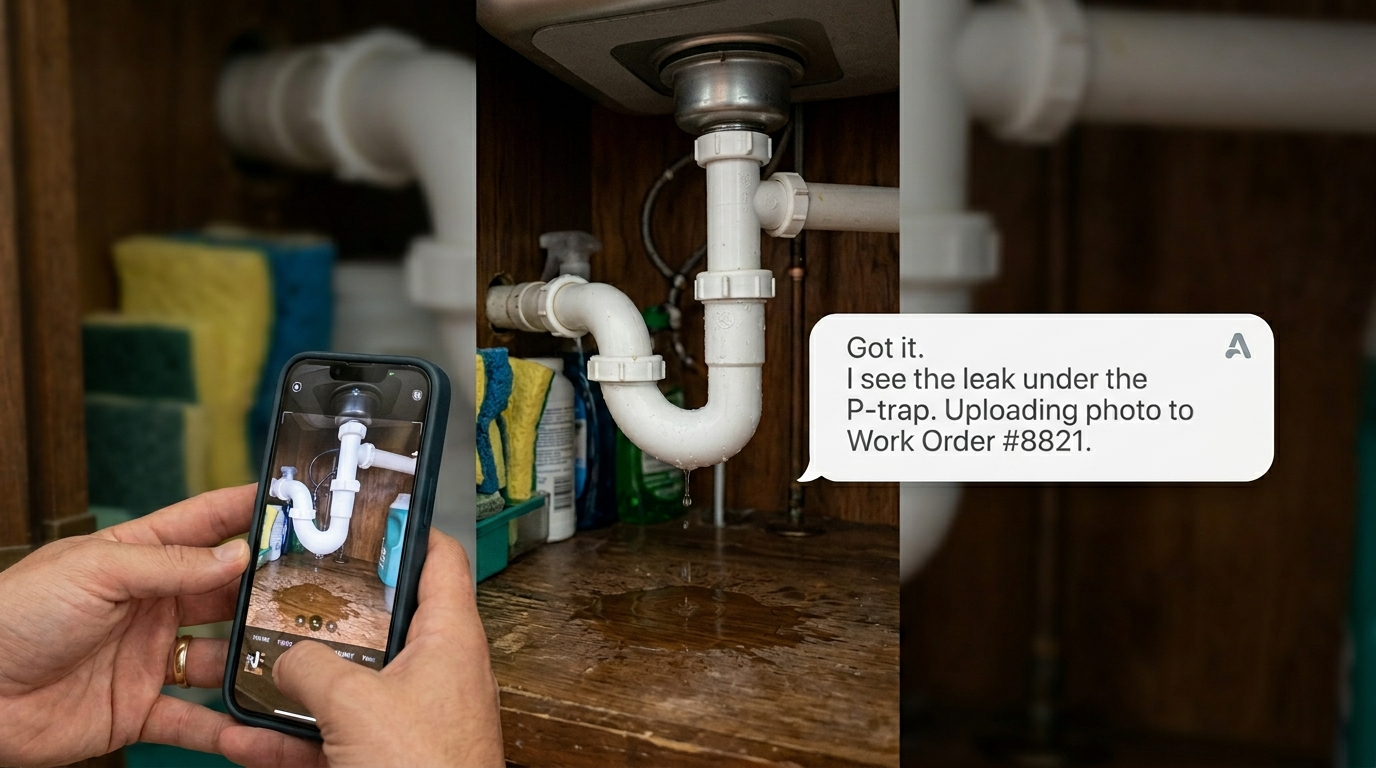
AI-driven collection of maintenance request details through conversation, whether by phone, SMS, or tenant portal. Instead of a static form where tenants type “something’s broken,” intelligent intake asks follow-up questions, requests photos, identifies the affected system, and captures enough detail to create an actionable work order.
This eliminates what practitioners call the “callback loop,” where coordinators spend hours chasing tenants for basic information like which unit, what’s leaking, and when it started.
Best practice: Ensure your intake system collects photos, issue descriptions, location data, and urgency indicators upfront. Every missing detail at intake becomes a phone call later. Voice-first intake (phone and SMS) reaches more tenants than portal-only options, which matters for accessibility.
Emergency Triage / AI Triage
Automated classification of maintenance requests by urgency level. The AI analyzes the tenant’s description (and sometimes photos) to determine whether a request is an Emergency, Urgent, or Routine issue, then routes it accordingly.
This is one of the highest-value maintenance AI best practices because the data is striking: 40% of issues that residents report as emergencies aren’t actually emergencies. An AI system that accurately reclassifies those saves significant after-hours dispatch costs and reduces unnecessary vendor callouts.
Best practice: Audit triage accuracy monthly. Look for both false positives (routine issues classified as emergencies) and false negatives (real emergencies classified as routine). If you want to understand how triage works in practice, this emergency maintenance triage guide covers the full decision framework.
Urgency Scoring
A numerical or categorical rating (typically Emergency, Urgent, or Routine) assigned by AI based on the details collected during intake. Good urgency scoring accounts for context, not just keywords.
Here’s why context matters: “no heat” at 11 PM in January is a potential emergency involving frozen pipes and habitability risk. “No heat” at noon in May is routine. Keyword matching alone can’t tell the difference. Pattern recognition and contextual models can.
Best practice: Calibrate urgency scoring to your market and seasonal conditions. A system trained on properties in Phoenix will misjudge urgency for a portfolio in Minneapolis if it doesn’t account for climate.
NLP (Natural Language Processing)
The technology that allows AI to understand what tenants describe in their own words. When a tenant says “there’s water coming from under the dishwasher and it smells weird,” NLP parses that into structured categories: appliance issue, water leak, potential mold risk.
Best practice: Look for systems that understand context and intent, not just keyword matching. A tenant saying “my toilet keeps running” and “my toilet is overflowing” describe very different urgency levels. The AI should recognize that.
Self-Resolution Guidance
AI-driven troubleshooting walkthroughs that help tenants resolve simple issues before a vendor is dispatched. Common examples include resetting a garbage disposal, flipping a tripped breaker, relighting a pilot light, or adjusting a thermostat.
This reduces unnecessary work orders while still giving tenants immediate help. The key is that guidance must be genuinely useful, not a frustrating runaround that makes tenants feel dismissed.
Best practice: Track self-resolution rate as a KPI (more on this in the measurement section). Target 15 to 25% for a mature system. If the rate is much higher, your AI may be deflecting issues that actually need a vendor.
Workflow and Operations Terms
These terms describe how maintenance AI best practices translate into daily operational workflows.
Work Order Automation
Automatic creation of structured, enriched work orders inside your PMS. The AI takes the information collected during intake (tenant description, photos, triage classification, unit and property details) and creates a complete work order without a human re-entering data.
This is where PMS integration becomes critical. An AI that creates a transcript or email summary for your team to manually enter into AppFolio, Buildium, or Rent Manager isn’t really automating work orders. It’s just adding a step.
Best practice: Require that AI-generated work orders include photos, tenant-reported details, triage classification, and the correct property/unit assignment. Partial automation creates partial trust, and your team will stop relying on it.
Vendor Dispatch Automation
AI-driven assignment of work orders to preferred vendors based on issue type, property location, vendor availability, and sometimes cost history. Instead of a coordinator scanning a spreadsheet or calling down a list, the system matches the job to the right vendor and sends the assignment automatically.
Best practice: Maintain a clean, current preferred vendor list. Vendor dispatch automation follows your rules, so if your vendor list has outdated contact information or retired contractors, the AI will faithfully dispatch to a dead end. Review vendor lists quarterly at minimum.
PMS Integration
A bidirectional connection between the AI system and your property management software. Bidirectional means the AI can both read data from your PMS (property info, unit details, tenant records) and write data back to it (work orders, notes, status updates).
Multiple industry sources emphasize that maintenance AI without PMS integration creates more work, not less. When intake tools, scheduling, and vendor networks connect directly to the PMS, teams get a single source of truth and cleaner handoffs between staff and vendors.
Best practice: Require native API integration, not CSV exports or manual syncs. Ask vendors specifically: does your system create work orders directly in my PMS, or does it generate data that my team still has to enter?
After-Hours Maintenance AI
AI that operates 24/7, handling calls, texts, and portal submissions when your team is offline. This is often the first maintenance AI capability property managers adopt because the pain is immediate and measurable: missed calls, delayed emergency responses, and expensive answering services that can’t actually triage.
After-hours is also where AI most clearly outperforms traditional call centers, which typically take messages rather than taking action.
Best practice: Set clear escalation paths for true emergencies that need a human immediately. Gas leaks, flooding, and fire damage should always have a rapid human escalation option, even when AI handles the initial contact. For a full walkthrough, see this after-hours maintenance AI guide.
Follow-Up Automation
Post-completion outreach to tenants, including satisfaction checks, confirmation that the issue was resolved, and status updates throughout the repair process. This is the step most property management teams skip when they’re overwhelmed, and it’s the step tenants care about most.
Best practice: Automate the first follow-up and routine status updates, but have a human handle unresolved complaints or negative feedback. Automation works well for “Was your repair completed?” but poorly for “I’m still upset about how long this took.” For more on structuring this, check out the AI maintenance follow-up guide.
Maintenance SLA (Service Level Agreement)
Time-bound commitments for response and resolution, categorized by issue severity. For example: emergency response within 1 hour, urgent response within 4 hours, routine response within 24 hours.
Best practice: Use AI triage data to set realistic SLAs by issue category. If your HVAC repairs consistently take 48 hours because of parts availability, setting a 24-hour SLA just guarantees you’ll miss it. Let the data guide the commitment.
Predictive and Advanced Terms
These concepts go beyond day-to-day coordination into longer-term asset management and advanced AI capabilities.
Predictive Maintenance
AI that forecasts equipment failure using historical maintenance data and (optionally) real-time sensor feeds. This is fundamentally different from AI maintenance coordination. Coordination handles live requests. Predictive maintenance tries to prevent those requests from happening.
The financial case is strong: emergency repairs cost 3 to 7 times more than planned maintenance, and predictive approaches can reduce total maintenance costs by 25 to 40%.
Best practice: Start with your highest-cost systems (HVAC, plumbing, water heaters) before expanding to lower-risk equipment. Predictive maintenance requires good historical data, so it works best for portfolios that have been tracking work orders systematically for at least a year.
IoT Integration
Smart sensors (leak detectors, HVAC monitors, humidity sensors) feeding real-time data to AI for continuous monitoring. When a sensor detects an anomaly, the AI can automatically create a work order before the tenant even notices a problem.
Best practice: Prioritize water leak sensors and HVAC monitors for the fastest ROI. Water damage is both common and expensive, making leak detection the clearest win for IoT in rental properties.
Conversation Memory / Continuity
The AI’s ability to remember past interactions with a specific tenant across multiple contacts and communication channels. If a tenant called about a leaky faucet on Monday and texts back on Wednesday asking for an update, the AI should know about the Monday call without the tenant repeating everything.
Best practice: Ensure the system retains context across channels (phone, SMS, portal). A tenant shouldn’t have to re-explain their issue every time they switch from one communication method to another.
Measurement and ROI Terms
You can’t manage maintenance AI best practices without measuring them. These are the KPIs that matter.
For a broader look at the data behind these metrics, the AI property management statistics roundup covers industry-wide benchmarks.
Time to Triage (TTT)
The time from when a maintenance request is received to when it’s been classified by severity and routed to the appropriate next step. For AI systems, this should be measured in seconds or minutes, not hours.
Best practice: Benchmark TTT weekly and compare across channels (phone vs. SMS vs. portal). If one channel consistently shows longer triage times, investigate whether the intake flow for that channel needs adjustment.
Self-Resolution Rate
The percentage of maintenance requests resolved through AI-guided troubleshooting without dispatching a vendor. This directly reduces work order volume and vendor costs.
Best practice: Target 15 to 25% for a mature maintenance AI system. Track by issue type to identify which categories respond best to self-resolution guidance and which ones should skip straight to dispatch.
Cost Per Work Order
The total cost of completing a maintenance request, including vendor charges, parts, internal labor time, and dispatch overhead. One dataset showed AI coordination reducing average repair costs from $394 to $320 per repair.
Best practice: Compare cost per work order before and after AI implementation on a quarterly basis. Break it down by issue category for more actionable insights.
Containment Rate
The percentage of after-hours maintenance requests handled entirely by AI without requiring human escalation. This is the metric that most directly measures whether your after-hours AI is actually working or just collecting messages for the morning.
Best practice: Aim for 70% or higher containment for non-emergency requests. If your containment rate is below 50%, the AI likely isn’t collecting enough information during intake or doesn’t have sufficient authority to take action (create work orders, dispatch vendors).
Tenant Satisfaction Score
Post-service ratings collected after work order completion. AI systems can automate collection, which dramatically increases response rates compared to manual survey distribution. One dataset showed satisfaction scores improving from 4.11 to 4.36 out of 5 after AI implementation.
Best practice: Automate collection and track scores by issue type, response time, and vendor. This data helps you identify both your strongest vendors and the issue categories that need process improvement.
Compliance and Governance Terms
These maintenance AI best practices aren’t optional. They protect your residents and your business.
Fair Housing Compliance (AI Context)
Ensuring AI tools don’t discriminate in maintenance prioritization, response times, or communication accessibility. Most property managers think of Fair Housing as a leasing issue, but it applies squarely to maintenance. AI-driven prioritization could inadvertently favor certain buildings or unit types based on flawed algorithms or biased training data.
Over-reliance on digital-only tools could also exclude residents with visual impairments, limited English proficiency, or low digital literacy.
Best practice: Audit AI decisions quarterly for demographic bias. Maintain multiple communication channels (phone, SMS, and portal) so no resident is excluded from reporting maintenance issues. For a comprehensive look at compliance considerations, see this AI property management compliance and Fair Housing guide.
Data Quality
The accuracy and completeness of the data feeding your AI models. Both vendor leaders and independent practitioners emphasize this point consistently: AI models are only as good as the data they’re trained on. If your PMS has duplicate property records, outdated unit assignments, or incomplete vendor profiles, your AI will produce unreliable outputs.
Best practice: Clean your PMS data before implementation. Merge duplicate records, update unit details, verify vendor contact information, and standardize property naming conventions. Then schedule quarterly data hygiene reviews. This is the single most overlooked prerequisite in maintenance AI adoption.
Human-in-the-Loop
A design principle that keeps humans in critical decision chains rather than fully automating every outcome. AI handles routine classification and routing; humans step in for ambiguous situations, emergencies that require judgment, tenant disputes, or any scenario where getting it wrong has serious consequences.
Best practice: Always maintain human override capability. Define clear escalation triggers (specific emergency types, tenant complaints about AI interactions, situations involving potential liability) and make sure your team knows exactly when and how to take over.
Maintenance AI Interoperability & Security
As property management tech stacks become more complex in 2026, two factors dictate the success of your AI implementation:
SOC2 & Data Privacy: Ensure your AI vendor is SOC2 Type II compliant. Maintenance requests often contain PII (Personally Identifiable Information) and access codes to homes.
The API-First Mandate: Avoid "walled gardens." Your AI should communicate via Open API standards to ensure that if you switch your PMS (e.g., from AppFolio to Entrata), your maintenance data remains portable and accessible.
The Maintenance AI Best Practices Checklist
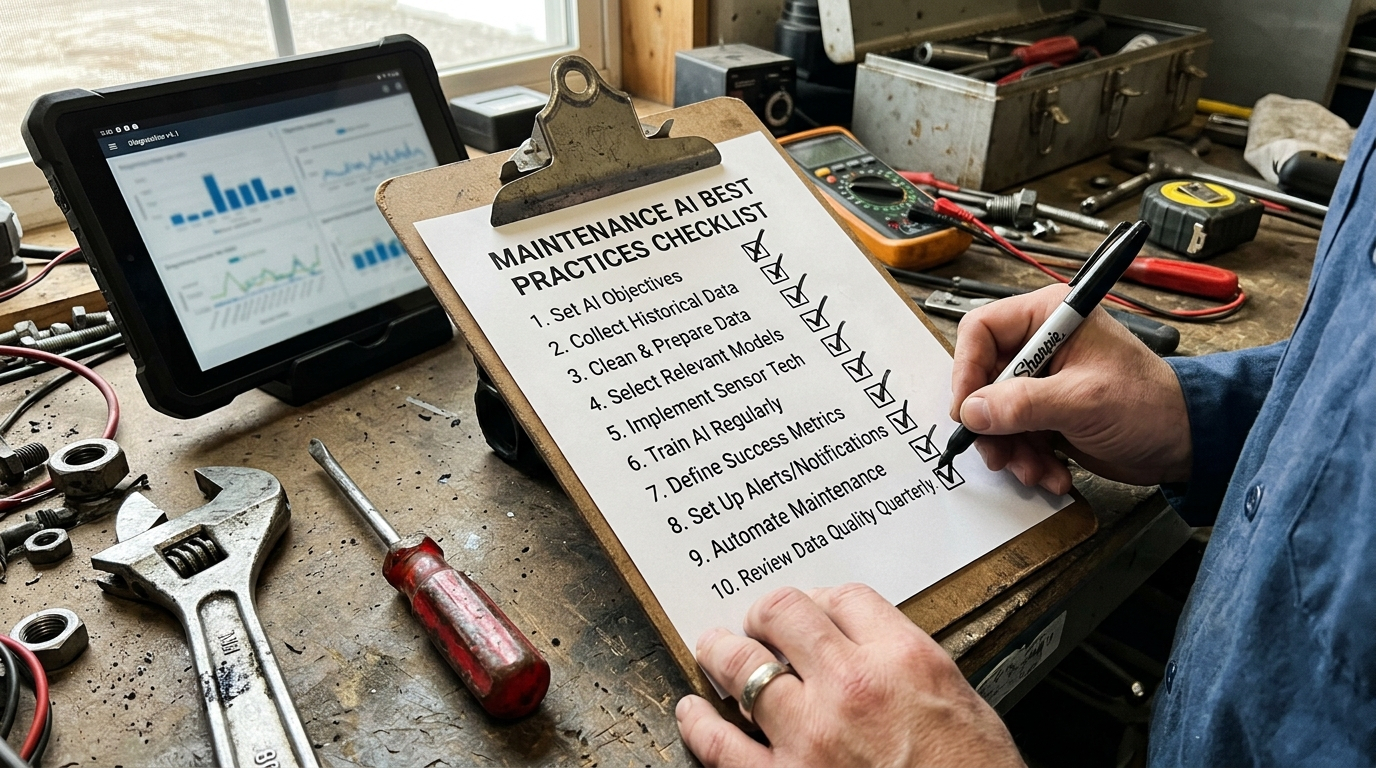
This is the synthesis. If you take nothing else from this glossary, apply these ten practices:
Define clear objectives before choosing a tool. “We want AI” is not an objective. “We want to reduce after-hours escalations by 60%” is.
Require native PMS integration. API-level connections, not data exports or manual re-entry.
Audit triage accuracy monthly. Check for both false positives and false negatives.
Train your team. AI assists operations; it doesn’t replace the need for staff to understand and trust the system.
Maintain multi-channel access. Phone, SMS, and portal access for Fair Housing compliance and tenant accessibility.
Track KPIs from day one. Time to Triage, self-resolution rate, cost per work order, containment rate, and tenant satisfaction.
Keep vendor lists current and clean. Review quarterly. Remove inactive vendors. Update contact information.
Start with your highest-impact area. For most teams, that’s after-hours intake, then expand to daytime coordination and predictive maintenance.
Maintain human override for emergencies, disputes, and sensitive situations. No exceptions.
Review data quality quarterly. Dirty data produces unreliable AI outputs, regardless of how good the model is.
These maintenance AI best practices apply whether you’re managing 200 units or 20,000. The scale changes, but the fundamentals don’t.
Ready to see these practices in action? Book a demo to see how Haven’s Maintenance AI handles intake, triage, work order creation, vendor dispatch, and follow-up inside your existing PMS.
Frequently Asked Questions
What is the difference between maintenance AI and predictive maintenance?
Maintenance AI is the broader category covering all AI applied to maintenance workflows: intake, triage, work orders, vendor dispatch, and communication. Predictive maintenance is a specific subset that uses historical data and IoT sensors to forecast equipment failures before they happen. You can implement maintenance AI coordination without predictive maintenance, and most property managers do, starting with the coordination layer first.
How much does maintenance AI actually save?
The data varies by portfolio size and starting point, but industry reports show 28% maintenance cost reductions and average repair cost drops from $394 to $320 per work order when AI handles coordination. The biggest savings typically come from reduced false-emergency dispatches, fewer after-hours vendor callouts, and lower labor hours spent on manual intake and routing.
What’s the most important maintenance AI best practice for new adopters?
Clean your data first. Every experienced practitioner and vendor says the same thing: AI outputs are only as reliable as the PMS data feeding them. Before you turn on any AI tool, deduplicate records, update unit assignments, verify vendor contacts, and standardize your property naming conventions.
Does maintenance AI replace property managers?
No. AI handles routine, repetitive decisions at scale (classifying issues, dispatching known vendor types, sending status updates), freeing property managers to focus on complex situations, tenant relationships, and strategic decisions. The human-in-the-loop principle is a core maintenance AI best practice, not an afterthought.
How do I evaluate whether a vendor’s “maintenance AI” is real?
Ask these questions: What decisions does the AI make autonomously? What training data does the model use (property-management-specific or generic)? Does it create work orders directly in my PMS, or does it generate summaries for my team to process? Can it dispatch vendors, or does it just notify my team to dispatch? The answers separate genuine AI coordination from a chatbot with a marketing upgrade.
What about Fair Housing compliance with maintenance AI?
This is an underappreciated risk. AI maintenance prioritization must not discriminate based on protected classes, and digital-only communication channels can exclude residents with disabilities or limited English proficiency. Audit AI decisions for bias quarterly, maintain phone and SMS channels alongside any portal, and ensure human oversight remains part of every escalation path.
How long does it take to see ROI from maintenance AI?
Most property managers see measurable improvements within the first 30 to 90 days, particularly in after-hours containment rates and time-to-triage metrics. Full ROI, including reduced vendor costs and improved tenant retention, typically becomes clear within two to four quarters. Industry data suggests average ROI of 300% within two years for AI property management tools broadly.
Should I start with after-hours AI or full-day coordination?
Start with after-hours. The pain is most acute (missed calls, delayed emergencies, expensive answering services), the baseline is easy to measure, and tenant expectations at night are more predictable than during business hours. Once after-hours is running smoothly, expand to daytime coordination with confidence that the system works.