AI Call Routing for Property Management: 2026 Guide
Learn how AI call routing in property management answers, triages, and dispatches 24/7—creating work orders and booking tours. See KPIs and ROI.

TL;DR
AI call routing in property management uses conversational AI to answer, classify, and direct tenant, prospect, and vendor calls to the right person or workflow automatically. Unlike traditional IVR systems that rely on button presses, AI call routing understands why someone is calling through natural conversation, then takes action: creating work orders, dispatching vendors, or booking tours. With over 60% of multifamily calls going unanswered, this technology addresses one of the industry’s most expensive operational failures.
AI call routing for property management uses conversational AI to answer every inbound call, understand why the caller is calling, classify urgency, and either resolve the issue automatically or route it to the correct person or workflow.
Unlike traditional IVR systems that rely on menu selections, AI routing understands natural speech and can perform operational tasks such as:
- Creating maintenance work orders
- Dispatching approved vendors
- Booking leasing tours
- Answering tenant questions
- Escalating emergencies
- Logging every interaction into the property management system
For most property management companies, AI call routing reduces missed calls, improves leasing response times, provides 24/7 coverage, and eliminates many repetitive administrative tasks.
AI Call Routing at a Glance
Feature | AI Call Routing |
|---|---|
Answers Calls | Yes (24/7) |
Understands Natural Speech | Yes |
Creates Work Orders | Yes |
Dispatches Vendors | Yes |
Books Leasing Tours | Yes |
Routes Emergencies | Yes |
Integrates with PMS | Yes |
Handles Multiple Properties | Yes |
Average Setup Time | Days to Weeks |
Best For | Property managers, multifamily operators, HOA management companies |
What Is AI Call Routing in Property Management?
AI call routing in property management is a system that uses conversational AI to automatically answer inbound calls, identify the caller, determine their intent, classify urgency, and direct the call to the right person, department, or automated workflow. It does this without IVR menus, hold queues, or human operators.
The key distinction from traditional call routing is simple. Traditional systems ask callers to press buttons (“Press 1 for maintenance, press 2 for leasing”). AI call routing has a conversation. The caller says what they need in their own words, and the system figures out what to do.
But routing is actually the wrong word for what modern systems do. A more accurate description is “AI-powered call handling with action execution.” The AI doesn’t just send calls to the right extension. It creates work orders, dispatches vendors from preferred lists, books apartment tours, and logs everything to the property management system. The core distinction, as practitioners describe it, is message-taker versus action-taker.
This matters because call routing in property management is more complicated than in most industries. A single management company might handle calls for dozens of properties, each with different maintenance vendors, on-call staff, escalation protocols, and office hours. Traditional routing can’t account for that complexity. AI can.
See how AI call routing works in a property management context with a live demo.
How AI Call Routing Works in Property Management
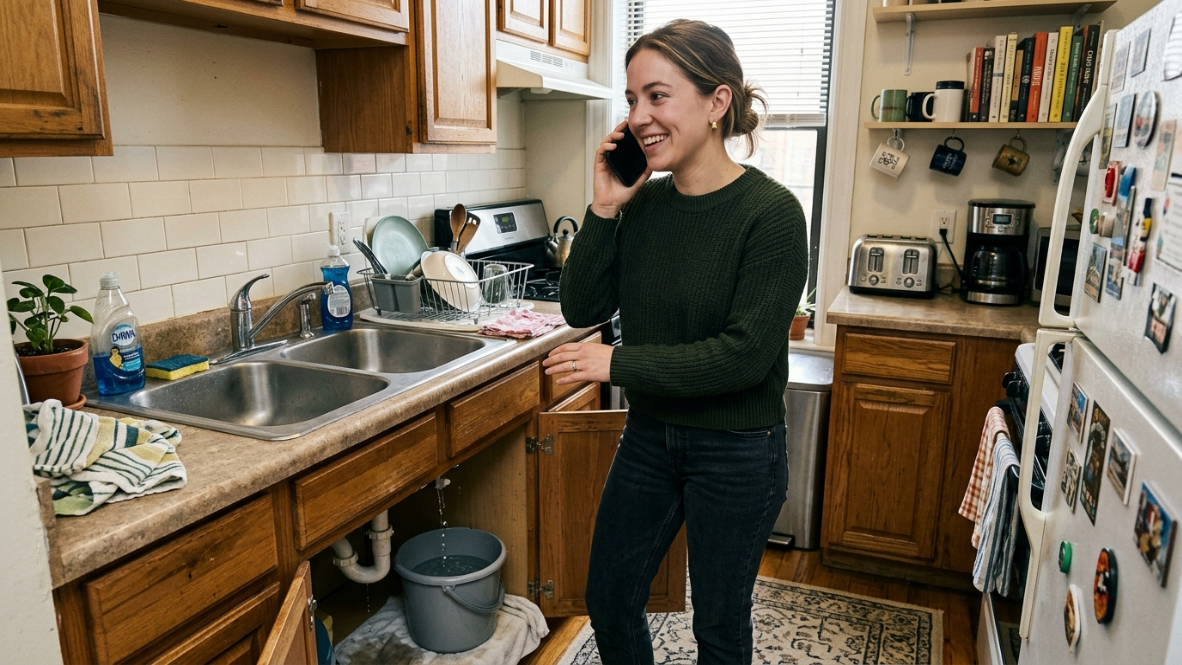
The AI call routing process follows a specific sequence. Each step builds on the previous one, and the entire interaction typically takes under two minutes.
Step 1: Answer and Identify
When a tenant calls, the AI answers immediately. No hold music, no “your call is important to us” recordings. The system matches the incoming phone number against the PMS tenant database to identify who’s calling and which property they belong to. If the caller is a prospect, the AI recognizes that too and shifts into leasing mode.
For multi-property portfolios, the AI identifies the property by the called phone number and applies that property’s specific rules and contacts. This is critical for companies managing scattered-site portfolios where each property may have different vendors and staff.
Step 2: Detect Intent
Through natural conversation, the AI determines why the caller is calling. Is it a maintenance issue? A leasing inquiry? A billing question? A noise complaint? The system uses an intent determination layer so it can understand what the caller actually needs, not just which department they think they should talk to.
This step is where AI call routing pulls ahead of any traditional system. A tenant might call saying “there’s water coming through my ceiling.” The AI recognizes this as a potential emergency maintenance issue, not a general inquiry. An AI maintenance coordinator can then take over the workflow from that point.
Step 3: Classify Urgency
The AI classifies the request into urgency tiers. Most systems use three levels: emergency (immediate escalation), urgent (next-day scheduling), and routine (scheduled maintenance). A flooding apartment gets treated differently than a request to fix a squeaky cabinet door.
This classification step is where the highest stakes live. We’ll cover misclassification risk later, but getting this right is the difference between a contained water leak and $50,000 in damage.
Step 4: Route or Resolve
Based on the classification and property-specific rules, the call goes one of several directions. The AI might resolve it entirely by walking the tenant through a troubleshooting step. It might route to on-call maintenance staff. It might create a work order and schedule a vendor visit. For leasing calls, it might qualify the prospect and book a tour.
Step 5: Act and Log
This is what separates AI call routing from an answering service. The AI creates work orders directly inside the PMS, dispatches vendors from pre-approved lists, sends confirmation messages to tenants, and logs the complete interaction. Nothing falls through the cracks because nothing depends on a human remembering to enter information later.
For a deeper look at what this sounds like in practice, check out this AI maintenance call example.
Types of AI Call Routing in Property Management
Not all routing decisions follow the same logic. Property management AI call routing systems typically support several routing types, often used in combination.
Emergency Escalation Routing
The most critical type. AI identifies genuine emergencies (flooding, fire, gas leaks, no heat in winter, broken entry locks, power outages) and immediately routes to on-call staff or dispatches pre-approved vendors. There’s no queue, no delay. The system treats these calls differently from the moment it detects the urgency.
Understanding how emergency maintenance triage works is essential for any property manager evaluating these systems.
Property-Based Routing
When a tenant calls about a leak, the AI identifies which building they’re in and routes to the correct superintendent or maintenance team. For a company managing 30 properties across a metro area, this eliminates the manual lookup step that used to eat minutes on every call.
Intent-Based Routing
Calls are directed based on what the caller needs: maintenance, leasing, billing, or something else. A prospect asking about availability gets routed to leasing workflows. A tenant asking about their rent balance gets routed to billing. This replaces the “Press 1 for…” menu tree with a natural conversation.
Cascading Escalation Routing
Multi-step escalation chains ensure someone always picks up. The system might try the superintendent first, then the backup super, then the property manager. Each property can have its own chain. This solves what portfolio operators describe as the “routing rules in someone’s head” problem, where escalation protocols exist only in the memory of one staff member. When that person quits or goes on vacation, the system breaks. AI codifies those rules permanently.
Sentiment-Based Routing
An emerging category. Some AI systems classify interactions by urgency and emotional tone, routing frustrated or at-risk residents directly to human property managers instead of keeping them in automated workflows. This is still early-stage, but it addresses the reality that some situations need a human touch regardless of the technical severity.
Time-Based Routing
Calls route differently based on time of day and staff availability. During business hours, leasing calls might go to the on-site team. After hours, the AI handles everything autonomously and only escalates true emergencies to on-call staff.
AI Call Routing Workflow Example
A typical maintenance request might follow this sequence:
Tenant reports a leaking ceiling.
AI identifies the resident.
AI confirms the property address.
AI determines the leak is active.
AI classifies it as an emergency.
AI creates a work order.
AI contacts the on-call maintenance technician.
AI sends confirmation to the resident.
AI logs the conversation inside the PMS.
Staff receive notifications immediately.
This entire process usually takes less than two minutes and requires no office staff intervention.
Why AI Call Routing Matters: The Numbers
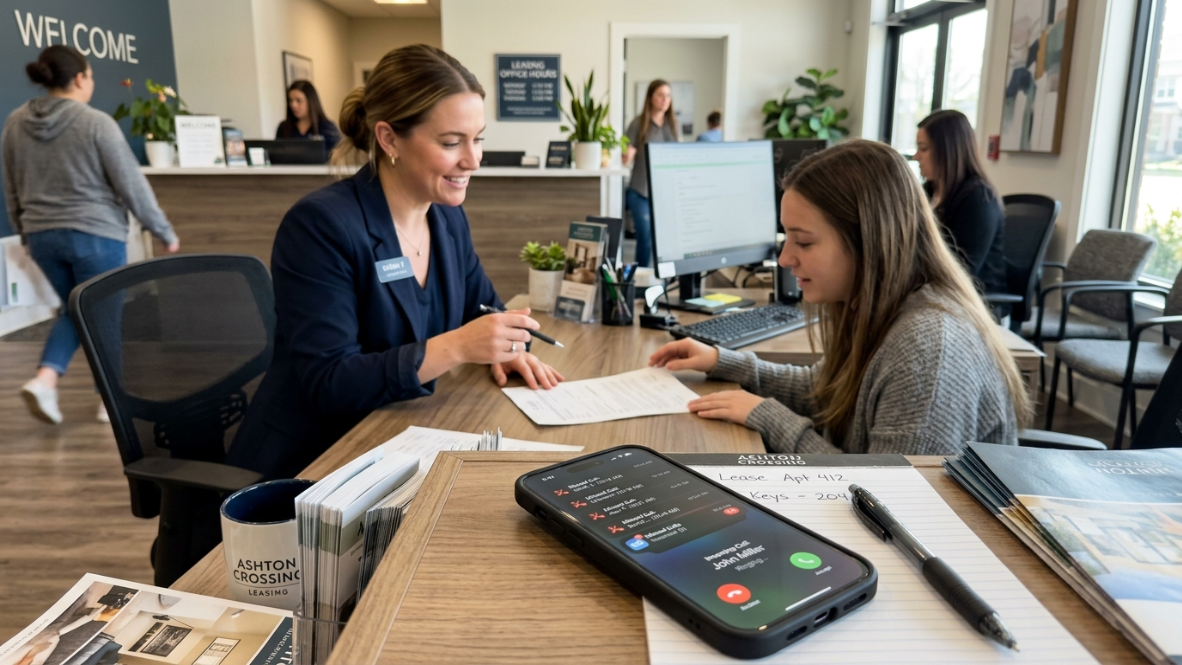
The case for AI call routing in property management isn’t theoretical. It’s driven by a structural problem: property management companies miss most of their calls.
The Missed Call Crisis
A Digible/Fiona analysis of 170,825 calls found that 60.8% of calls to multifamily properties go unanswered, with the problem worsening during peak inquiry times like weekday mornings and weekends. That’s not a rounding error. That’s the majority of incoming communication being lost.
The downstream effects compound fast:
65% of property management calls arrive outside standard business hours
85% of callers who reach voicemail never call back
62% of those callers contact a competitor instead
A single missed leasing call can cost $15,000 to $30,000 in annual revenue from that unit
Property managers spend roughly 40% of their time on tenant communications, according to NARPM. AI call routing doesn’t just answer missed calls. It frees up the time property managers spend on calls they do answer.
Speed-to-Lead Economics
For leasing calls specifically, response time is everything. A Harvard Business Review study found that responding within five minutes makes you 100 times more likely to connect with a lead compared to waiting 30 minutes. Separate research shows the first business to respond wins 78% of the time.
AI call routing answers every leasing inquiry within seconds, 24/7. For a property manager handling 30 calls per day across 100 units, capturing just three additional leasing leads per month at $1,000 each equals $36,000 in annual recovered revenue.
For a complete breakdown of the financial case, see this AI property management ROI guide.
Common Property Management Calls AI Can Route
AI routing is most effective when handling repetitive, high-volume conversations. Typical property management call types include:
Maintenance Requests
Plumbing leaks
HVAC issues
Appliance repairs
Electrical problems
Lockouts
Water heater issues
Leasing Calls
Apartment availability
Pricing
Tour scheduling
Pet policies
Application questions
Resident Services
Rent payment questions
Account balances
Parking issues
Amenity reservations
Community policies
Vendor Calls
Work order updates
Invoice questions
Arrival notifications
Material approvals
Emergency Calls
Flooding
Fire
Gas leaks
Broken entry doors
No heat
Power failures
AI Call Routing vs. Traditional Answering Services
Dimension | Traditional IVR/Answering Service | AI Call Routing |
|---|---|---|
Caller input | Button presses or speaking to an operator | Natural conversation |
Context | None, same script for every caller | Pulls PMS data, recognizes repeat callers |
Action capability | Takes a message, routes to voicemail | Creates work orders, dispatches vendors, books tours |
Emergency detection | Menu selection or operator judgment | Conversational intent plus keyword detection |
Capacity | Limited by operator headcount | Unlimited simultaneous calls |
After-hours handling | Voicemail or per-minute operator fees | Full autonomous handling at flat cost |
Cost structure | $175 to $470/month plus per-minute fees | $400 to $800/month flat for PM-specific platforms |
The Storm Surge Problem
Traditional answering services charge per minute or per call. During weather events (pipe bursts after a freeze, HVAC failures during a heat wave), call volumes can spike two to three times normal levels. AI call routing handles unlimited simultaneous calls at flat cost. Human answering services become cost-prohibitive during exactly the moments they’re needed most.
For a detailed comparison, read answering service vs. AI for property management.
Cost Benchmarks
Entry-level general AI tools start at $25 to $60 per month. Property-management-specific AI voice agents typically cost $400 to $800 per month. Enterprise platforms are custom-priced, often $300 to $600 per month per community. Traditional human answering services run $175 to $470 per month with per-minute or per-call fees on top, which add up fast during high-volume periods.
Example ROI Calculation
Portfolio Size | Missed Calls Per Month | Additional Leases | Estimated Annual Revenue Recovery |
|---|---|---|---|
100 Units | 30 | 2 | $24,000 |
250 Units | 80 | 6 | $72,000 |
500 Units | 150 | 12 | $144,000 |
AI Call Routing vs Human Receptionists
Feature | Human Receptionist | AI Call Routing |
|---|---|---|
24/7 Availability | Limited | Yes |
Simultaneous Calls | Limited | Unlimited |
PMS Integration | Rare | Yes |
Creates Work Orders | Usually No | Yes |
Vendor Dispatch | Manual | Automatic |
Consistent Responses | Varies | Yes |
Cost | High | Predictable Monthly Fee |
Response Time | Depends on Staff | Immediate |
What to Look For in AI Call Routing for Property Management
Not all AI call routing systems are built for property management. Generic voice AI platforms lack the domain knowledge and PMS integrations that make the technology actually useful. Here’s what matters.
PMS Integration Depth
The AI needs to read from and write to your property management system. Reading tenant records for caller identification is table stakes. Writing work orders, updating ticket statuses, and logging notes, that’s where real operational value lives. Ask whether the integration creates work orders directly in your PMS or just sends you an email summary. Those are very different things.
For AppFolio users specifically, here’s a guide to AI work order creation in AppFolio.
Emergency Classification Accuracy
This is the single most important evaluation criterion. Practitioners on Reddit and in hands-on product testing report that budget AI tools sometimes treat an urgent leak the same as a routine message. Emergency misclassification is the costliest error in AI call routing. Test the system against your own real-world call scenarios before deploying. A good system lets you configure emergency rules specific to your properties, not just rely on generic defaults.
Containment Rate
Containment rate measures the percentage of calls resolved without dispatching a technician. Truck rolls are expensive: labor, travel, overtime, and often a second visit when the original details were incomplete. Industry benchmarks suggest 15 to 25% of routine maintenance calls can be safely contained through guided troubleshooting. If a portfolio fields 500 maintenance calls per month and contains 20% of routine issues at a $150 average truck roll cost, that’s roughly $15,000 per month in avoided expenses. This metric is underappreciated in vendor evaluations.
Multi-Property Awareness
For portfolio operators, the AI needs to know which property it’s answering for, which vendors serve that address, and which escalation chain to follow. A system that treats your entire portfolio as one property is worse than useless for scattered-site or multi-market operators.
Fair Housing Compliance
AI call routing must follow Fair Housing rules. The system cannot screen callers or route calls differently based on protected characteristics. Routing rules must be applied uniformly across all callers for a given property. Conversations should be recorded and logged for audit trails. This is a weak-coverage area in most vendor marketing, but it’s a real compliance requirement. Read more about Fair Housing compliance for AI in property management.
Bilingual Support
In many markets, supporting Spanish-speaking tenants isn’t optional. Multi-language voice support should be a core feature, not an add-on.
Key Performance Metrics for AI Call Routing
Once deployed, track these KPIs to measure whether AI call routing is actually working.
First Response Time (FRT): Time from ring to acknowledgment. For emergencies, target under 60 seconds. AI should answer every call within a few seconds.
Time to Triage (TTT): Time from ring to completed severity classification with structured details captured. This measures how quickly the system understands what’s happening and what needs to happen next.
Containment Rate: Percentage of calls resolved through guided steps without a truck roll. Benchmark is 15 to 25% for routine maintenance calls.
Resolution Time: AI routing has been shown to cut ticket resolution time by 33% compared to manual processes, according to Gitnux data. Track your own before-and-after numbers.
Leasing Conversion Rate: For leasing calls, measure how many AI-handled inquiries convert to tours and then to signed leases.
The Adoption Picture
AI call routing for property management isn’t speculative anymore. AI usage among property managers jumped from 21% in 2024 to 34% in 2025, and organizations using AI in property management report a 20 to 30% improvement in operational efficiency.
The AI voice agents market was valued at $2.54 billion in 2025 and is forecast to reach $35.24 billion by 2033, with property management as one of its fastest-moving verticals. That said, skepticism about AI accuracy remains the number-one barrier to adoption, cited by 40% of property managers in 2025 surveys. This skepticism is healthy. It’s why testing emergency classification accuracy before deployment matters so much.
Book a demo with Haven to see how AI call routing handles maintenance triage, leasing inquiries, and vendor dispatch inside your PMS.
How to Implement AI Call Routing
Step 1
Document your current call workflows.
Step 2
Identify emergency escalation rules.
Step 3
Connect your PMS.
Step 4
Configure routing rules for each property.
Step 5
Import vendor contact lists.
Step 6
Train the AI using common tenant conversations.
Step 7
Run test calls for emergency scenarios.
Step 8
Launch gradually while monitoring KPIs.
Future Trends in AI Call Routing
Over the next several years, AI call routing platforms are expected to expand beyond call handling by incorporating:
Voice biometrics for caller verification
Predictive maintenance recommendations
AI-generated maintenance summaries
Real-time translation across dozens of languages
Outbound appointment reminders
Integration with IoT building sensors
Automated vendor bidding
AI-powered resident satisfaction analysis
These capabilities will move AI from simple routing toward fully autonomous property operations.
Key Takeaways
AI call routing replaces IVR menus with conversational AI.
The technology identifies callers, understands intent, classifies urgency, and completes operational workflows.
Property management companies use AI routing to reduce missed calls, improve leasing conversion, and automate maintenance coordination.
The most valuable capabilities include PMS integration, emergency classification, vendor dispatch, multilingual support, and automated work order creation.
Success should be measured using response time, containment rate, leasing conversion, and resolution time rather than call volume alone.
Frequently Asked Questions
How is AI call routing different from a regular IVR phone tree?
Traditional IVR systems use pre-recorded menus and button presses to route calls. AI call routing uses natural language processing to understand what the caller is saying in their own words. It also pulls context from your PMS (who the caller is, which property they belong to, their open work orders) to make smarter routing decisions and take action automatically.
Can AI call routing handle real emergencies?
Yes, but accuracy varies by platform. The best systems let you configure emergency criteria specific to your properties and immediately escalate to on-call staff or dispatch vendors for situations like flooding, gas leaks, or no heat in winter. Always test emergency scenarios before going live. Misclassification of emergencies is the highest-risk failure mode.
What happens if the AI can’t understand a caller?
Good AI call routing systems have fallback protocols. If the system can’t determine intent after a reasonable attempt, it escalates to a human, either a live staff member during business hours or an on-call manager after hours. The call is still logged with whatever information was captured.
Does AI call routing work for small portfolios?
It can, though the ROI calculation depends on call volume. A property manager with 50 units receiving 10 calls a day will see different economics than one managing 500 units. The fixed cost of PM-specific AI ($400 to $800 per month) needs to be weighed against missed calls, after-hours coverage gaps, and staff time savings.
How does AI call routing handle multiple properties?
The AI identifies which property the caller is associated with (through the phone number dialed or tenant database lookup) and applies property-specific routing rules. Each property can have its own vendor lists, escalation chains, office hours, and FAQ responses.
Is AI call routing compliant with Fair Housing laws?
It must be. AI call routing should apply identical routing rules regardless of caller characteristics. Systems should log all interactions for audit purposes. The AI should not make routing decisions based on any protected class information. Verify that any vendor you evaluate has considered this explicitly, not as an afterthought.
How long does it take to set up AI call routing?
Implementation timelines vary. Some platforms can be configured in days, while enterprise deployments across large portfolios may take several weeks. The main variables are PMS integration complexity, the number of properties, and how detailed your routing rules need to be. An AI implementation timeline guide can help you plan.
What’s the difference between AI call routing and an AI answering service?
An AI answering service takes messages. AI call routing determines intent, classifies urgency, and takes operational action: creating work orders, dispatching vendors, booking tours, and logging everything to your PMS. The answering service gives you a note. AI call routing gives you a completed workflow.