AI SLAs for After-Hours Support: 2026 Guide to 8 Metrics
In this 2026 guide, learn how to define AI SLAs for After-Hours Support with 8 core metrics, benchmarks, and vendor questions. Get the checklist.

TL;DR
An AI SLA for after-hours support is a formal agreement that defines how an AI agent should perform when handling tenant calls, texts, and emails outside business hours. Unlike traditional SLAs that focus on uptime, AI SLAs must measure quality outcomes like triage accuracy, escalation speed, and data correctness. This guide breaks down the eight core metrics property managers should demand, the benchmark tiers that define reasonable performance, and the questions to ask any vendor before signing a contract.
An effective AI SLA for after-hours property management support should measure more than uptime. The most important metrics are emergency triage accuracy, escalation speed, first response time, PMS data accuracy, hallucination rate, containment rate, follow-up completion, and system availability. Property managers should expect 99.99% uptime, emergency escalation within three minutes, and at least 95% triage accuracy from enterprise-grade AI vendors.
AI SLA Metrics at a Glance
Metric | Good Target | Why It Matters |
|---|---|---|
Uptime | 99.99% | AI must always answer after-hours |
First Response | Under 10 sec (voice) | Prevent abandoned calls |
Emergency Triage Accuracy | 95%+ | Avoid missed emergencies |
Escalation Success | 98% within 3 min | Ensure humans are reached |
Containment Rate | 60–80% | Reduce staffing costs |
PMS Data Accuracy | 95%+ | Prevent bad work orders |
Hallucination Rate | Under 1% | Reduce legal risk |
Follow-up Completion | 95%+ | Reduce duplicate calls |
What Is an AI SLA for After-Hours Support?
An AI SLA (Service Level Agreement) for after-hours support is a measurable contract between a property management company and an AI service provider. It defines the performance standards the AI agent must meet when handling tenant interactions outside normal business hours, typically evenings, weekends, and holidays.
This is not the same thing as a traditional software SLA that promises 99.9% uptime and calls it a day. It is also not the same as a call-center SLA built around average handle time and abandonment rates. An AI SLA for after-hours support sits at the intersection of both, because the AI agent is simultaneously a software system that needs to stay online and an autonomous decision-maker that needs to triage emergencies correctly at 2 a.m.
The distinction matters because after-hours answering services have historically relied on human operators. When you replace or augment those humans with AI, the SLA framework has to change.
To understand how these agreements work, it helps to know three related terms:
SLA (Service Level Agreement): The customer-facing promise. “We guarantee emergency calls will be escalated to on-call staff within 3 minutes.”
SLO (Service Level Objective): The internal target the vendor sets, often stricter than the SLA. “We target escalation within 90 seconds.”
SLI (Service Level Indicator): The actual measurement. “Median escalation time last month was 47 seconds.”
When evaluating AI vendors, ask which of these three they are quoting. A vendor bragging about their SLI while refusing to put an SLA in writing is telling you something.
Explore Haven’s AI property management software →
Why After-Hours SLAs Matter More Than Daytime Ones

During business hours, a human team can catch AI mistakes. If the AI misclassifies a maintenance request, someone on staff can correct it within minutes. After hours, the AI IS the entire support operation. There is no safety net. That asymmetry means after-hours SLAs need to be more rigorous, not less.
The numbers make the case clearly:
67% of maintenance emergencies happen outside standard business hours. A burst pipe at midnight doesn’t wait for the office to open. According to industry data, the average burst pipe runs about $4,000 in repairs when you factor in remediation and displacement costs. After-hours rates and rush parts can double that figure, so every hour of delayed response inflates the bill.
49 to 60% of calls to multifamily properties go unanswered, and 85% of those callers never call back. That’s not just a missed maintenance request. It’s a missed opportunity to prevent property damage, retain a tenant, or capture a leasing lead.
67% of tenants who choose not to renew cite unresolved or slow maintenance response as a primary factor. Tenant turnover costs thousands in vacancy loss, marketing, and make-ready expenses. An AI SLA that ensures rapid, competent after-hours response directly protects revenue.
For a deeper look at how after-hours performance affects retention, see this guide on after-hours tenant satisfaction.
How AI SLA Performance Directly Affects NOI
Many property managers evaluate AI based on monthly subscription cost instead of financial impact. A better approach is measuring how SLA performance influences Net Operating Income (NOI).
Higher SLA performance can reduce:
Emergency repair costs through faster dispatch
Tenant turnover caused by delayed maintenance
Leasing lead abandonment
Staff overtime
Administrative work correcting bad tickets
Example:
A community receiving 300 after-hours contacts per month that improves emergency response by 30 minutes could prevent thousands of dollars in avoidable damage annually while reducing manual workload for onsite staff.
Ultimately, SLA quality should be viewed as an operational investment rather than simply a technology metric.
How AI SLAs Differ from Traditional SLAs
Traditional software SLAs are mostly binary. The system is up or it’s down. You measure availability as a percentage, define what counts as downtime, and negotiate service credits for breaches. Simple enough.
AI breaks this model. An AI agent can be technically online, returning HTTP 200 responses, accepting calls, and generating work orders, while simultaneously failing tenants in ways that don’t show up on an uptime dashboard. It might misclassify a gas leak as a non-urgent request. It might hallucinate a vendor phone number. It might write garbled notes into your property management system that create rework the next morning.
This is the central concept property managers need to understand: uptime does not equal working.
According to Maven AGI’s analysis of AI service agreements, AI models left unchanged for six or more months saw error rates jump 35% due to model drift, even while maintaining perfect uptime. The AI is “on,” but its accuracy has quietly degraded because the underlying data or decision patterns shifted.
Traditional SLAs measure availability. AI SLAs must also measure quality. That means tracking whether the AI made the right decision, not just whether it made a decision at all.
For property managers, this distinction has real consequences. If your AI and PMS integration creates work orders with wrong unit numbers or missing descriptions, you have an AI that’s “working” by every traditional metric while actively creating problems.
Traditional SLA vs AI SLA
Traditional Software SLA | AI SLA |
|---|---|
Measures uptime | Measures outcomes |
Focuses on servers | Focuses on decisions |
Tracks availability | Tracks accuracy |
Binary (up/down) | Continuous quality |
Static software | Continuously evolving model |
Few metrics | Multiple operational metrics |
The 8 Core Metrics in an After-Hours AI SLA
No ranking page currently bundles these metrics for the property management context. This framework synthesizes AI agent SLA research with property management operational standards.
1. Uptime / Availability
What it measures: The percentage of time the AI system is operational and accepting tenant interactions.
Benchmark: 99.9% minimum, with 99.99% as the standard for serious vendors. At 99.9%, you’re allowing about 8.7 hours of downtime per year. At 99.999% (“five nines”), you allow just 5.26 minutes per year.
Why it matters after hours: If the AI goes down at 2 a.m. on a Saturday, nobody is monitoring dashboards to notice. The system needs to be self-healing or have automatic failover.
2. First Response Time
What it measures: The elapsed time from when a tenant calls, texts, or emails to when the AI delivers its first meaningful response.
Benchmark: Single-digit seconds for voice; under 30 seconds for text/email acknowledgment.
Why it matters after hours: This is the primary reason you have an AI agent. One property management case study showed average response time dropping from 6 hours to under 2 minutes after deploying AI. If the AI isn’t responding in seconds, it’s not doing its job.
3. Emergency Triage Accuracy
What it measures: The percentage of emergency situations correctly classified as emergencies (and non-emergencies correctly classified as non-emergencies).
Benchmark: 95%+ for true emergency detection. False negatives (a real emergency classified as routine) should be under 2%.
Why it matters after hours: This is the highest-stakes metric in any AI SLA for after-hours support. A flood classified as “routine” can cause $30,000+ in property damage. A false alarm that wakes up your on-call tech at 3 a.m. is annoying but recoverable. A missed emergency is not. For a detailed breakdown of how AI triage works, see the emergency maintenance triage guide.
4. Escalation Success Rate
What it measures: The percentage of true emergencies successfully routed to on-call human staff within the defined time window.
Benchmark: 98%+ within 3 minutes. The escalation path should include fallback contacts if the primary on-call person doesn’t respond.
Why it matters after hours: Correct triage means nothing if the handoff fails. The AI must not just identify the emergency but actually reach a human. This metric should track whether the on-call tech acknowledged the notification, not just whether the notification was sent.
5. Containment / Resolution Rate
What it measures: The percentage of tenant inquiries fully resolved by the AI without any human involvement.
Benchmark: 60 to 80% for a mature system. One practitioner case study reported roughly 80% autonomous resolution.
Why it matters after hours: This is the metric that drives ROI. Every issue the AI resolves independently is one your team doesn’t have to handle in the morning.
6. PMS Write Accuracy
What it measures: The percentage of work orders, notes, and updates created correctly in your property management system.
Benchmark: 95%+ accuracy on critical fields (unit number, issue category, priority level, tenant contact info).
Why it matters after hours: Garbage data means rework. If your staff spends the first hour of every morning correcting AI-generated work orders, you’ve traded one problem for another. Learn more about this in the AI maintenance coordinator guide.
7. Hallucination / Guardrail Rate
What it measures: The percentage of AI responses that contain fabricated information, off-policy commitments, or unauthorized promises.
Benchmark: Under 1% for policy-critical responses. Zero tolerance for Fair Housing violations.
Why it matters after hours: An AI that promises a tenant their rent will be waived, or that gives incorrect move-in dates, creates legal and operational liabilities. In the property management context, hallucination isn’t just embarrassing. It can violate Fair Housing rules if the AI gives inconsistent information to different callers.
8. Follow-Up Completion Rate
What it measures: The percentage of resolved issues where the AI sends a follow-up confirmation to the tenant.
Benchmark: 95%+ within the defined follow-up window.
Why it matters after hours: Closing the loop prevents repeat calls. A tenant who reported a leak at midnight and hears nothing back will call again at 8 a.m., creating duplicate work. Automated follow-ups are one area where AI consistently outperforms human teams.
Which AI SLA Metrics Matter Most?
Not every SLA metric carries the same business risk.
Critical
Emergency triage accuracy
Escalation success
Hallucination rate
Failures here can create safety, legal, or property damage risks.
High Priority
First response time
PMS write accuracy
Uptime
These affect operational efficiency and tenant experience.
Optimization Metrics
Containment rate
Follow-up completion
These primarily improve ROI and customer satisfaction.
Property Management SLA Tiers: A Benchmark Framework
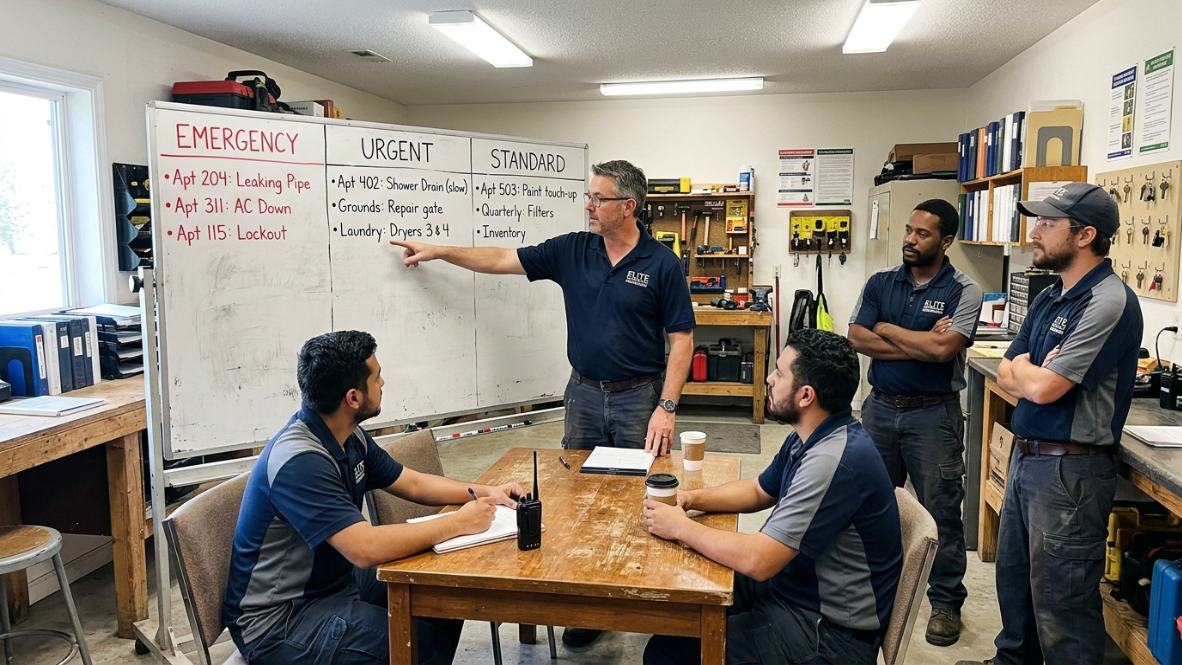
Most property managers don’t know what “reasonable” SLA targets look like. The framework below aligns with BOMA and IFMA industry benchmarks and maps each tier to AI-specific expectations.
Emergency Tier
Examples: Fire, flooding, gas leak, no heat in extreme cold, security breach, sewage backup.
Time Dimension | Traditional Target | AI-Enhanced Target |
|---|---|---|
Acknowledgment | Within 1 hour | Under 30 seconds |
Response (tech dispatched) | Within 2 hours | Within 2 hours (AI dispatches, human responds) |
Resolution | Within 4 hours | Within 4 hours |
Follow-up | Within 24 hours | Within 2 hours of resolution |
Urgent Tier
Examples: No hot water, broken lock, HVAC failure in moderate conditions, appliance malfunction affecting habitability.
Time Dimension | Traditional Target | AI-Enhanced Target |
|---|---|---|
Acknowledgment | Within 1 hour | Under 30 seconds |
Response | Within 8 hours | Within 8 hours |
Resolution | Within 24 hours | Within 24 hours |
Follow-up | Within 48 hours | Within 4 hours of resolution |
Standard Tier
Examples: Cosmetic issues, minor repairs, non-urgent appliance replacement, general questions.
Time Dimension | Traditional Target | AI-Enhanced Target |
|---|---|---|
Acknowledgment | Within 1 hour | Under 30 seconds |
Response | Within 48 hours | Within 48 hours |
Resolution | Within 5 business days | Within 5 business days |
Follow-up | Within 5 business days | Within 24 hours of resolution |
Notice how AI compresses the acknowledgment layer from hours to seconds across all tiers. That’s the immediate, measurable impact. Broader data backs this up: average maintenance response times dropped from 4.6 days to under 18 hours within 30 days of AI implementation across studied properties.
For more on how AI handles intake across all three tiers, see the 24/7 maintenance request intake breakdown.
How to Measure AI SLA Performance Every Month
Signing an SLA is only the beginning. Property managers should review performance monthly using vendor reports and their own PMS data.
Track:
Total after-hours interactions
Emergency classifications
Escalation success
Average response time
Resolution rate
Repeat contacts
False emergency rate
Tenant satisfaction after AI interactions
Monthly reporting helps identify model drift before service quality declines.
What to Ask Your AI Vendor About SLAs
Most AI vendors will tell you their system is “available 24/7.” That statement alone is meaningless without defined performance standards. Here are the specific questions to ask before signing any agreement.
1. “What is your uptime guarantee specifically for nights, weekends, and holidays?”
Some vendors measure uptime across all hours and let off-peak outages dilute into acceptable averages. Demand a separate uptime metric for after-hours periods.
2. “How do you measure and report triage accuracy?”
If the vendor can’t explain their methodology for testing emergency classification accuracy, they probably don’t have one. Ask for sample accuracy reports.
3. “What is the escalation path when the AI cannot resolve an issue, and what’s the SLA for that handoff?”
The escalation workflow is where many AI systems fail silently. The AI should attempt to reach on-call staff through multiple channels (call, SMS, app notification) with defined timeout thresholds.
4. “How often is the model updated, and how do you prevent drift?”
Models degrade over time. A serious vendor will have a monitoring and retraining cadence, not just an annual review.
5. “Do you offer service credits for SLA breaches?”
Service credits signal confidence. If a vendor won’t put money behind their SLA, their commitment to meeting it is questionable.
6. “What Fair Housing compliance safeguards are built into the AI?”
Every caller should receive consistent treatment regardless of accent, tone, or perceived demographics. AI systems apply the same decision logic to every interaction, which creates a more reliable compliance baseline than human agents, but only if the vendor has explicitly designed for it.
7. “What is your concurrent call capacity during surge events?”
During storms or leasing rushes, call volume spikes. Traditional call centers have capacity ceilings. Your AI SLA should define how many simultaneous interactions the system can handle without degradation.
Book a demo with Haven to see how these SLA principles work in practice.
Common Mistakes When Evaluating AI SLAs
Accepting “24/7 availability” without defined metrics. This is the most common mistake. A vendor saying “we’re always on” is marketing, not an SLA. You need specific numbers for each metric in the framework above.
Ignoring accuracy in favor of speed. An AI that answers in 3 seconds but misclassifies 15% of emergencies is worse than a slower system with 98% triage accuracy. Speed without correctness is dangerous.
Not defining emergency triage accuracy as a separate metric. Overall accuracy averages can hide poor emergency detection. If the AI correctly handles 95% of routine requests but misses 20% of true emergencies, the blended accuracy looks fine while the operational risk is severe.
Forgetting Fair Housing consistency. This is an underappreciated SLA dimension that practitioners on Reddit and industry forums increasingly flag. Human agents can inadvertently vary their tone, helpfulness, or urgency based on a caller’s accent or perceived demographics. AI applies the same script to everyone, which is a compliance advantage, but only if the vendor explicitly includes consistency commitments in their SLA.
Overlooking PMS data quality. The AI’s work doesn’t end when the call does. If it writes bad data into your PMS, your morning team inherits a mess. Always include PMS write accuracy in your SLA evaluation.
Assuming today’s performance is permanent. AI systems drift. The model that performed at 97% accuracy during onboarding might drop to 85% six months later without monitoring. Your SLA should include ongoing performance reporting requirements, not just launch-day benchmarks.
Common SLA Targets by Property Portfolio Size
Portfolio Size | Recommended SLA |
|---|---|
Under 500 units | 99.9% uptime |
500–2,000 units | 99.95% uptime |
2,000–10,000 units | 99.99% uptime |
10,000+ units | 99.99% uptime + redundancy |
Where AI SLA Standards Are Heading
The AI SLA space is evolving fast. A notable academic effort, the AgentSLA paper from ArXiv, proposes extending the ISO/IEC 25010 software quality standard with AI-agent-specific characteristics like autonomy, fairness, and output properties. It introduces a formal language for specifying SLAs that includes drift-aware monitoring and automated compliance checks.
While this framework is too academic for most property managers to implement directly, it signals something important: even researchers acknowledge that traditional SLA frameworks are insufficient for AI agents. The industry is moving toward standardized AI SLA metrics that include fairness commitments, real-time monitoring, and transparency requirements.
For property managers, the practical takeaway is this: AI adoption in the industry nearly doubled from 21% in 2024 to 34% in 2025. As more operators adopt AI for after-hours support, SLA standards will tighten. Getting familiar with these metrics now puts you ahead of the curve.
Yet 40% of property managers still cite accuracy concerns as their top barrier to AI adoption. A well-structured AI SLA directly addresses that skepticism by turning vague promises into measurable commitments.
Quick-Reference Glossary of Related Terms
SLA (Service Level Agreement): The contractual promise between vendor and customer defining minimum performance standards.
SLO (Service Level Objective): The internal performance target, typically stricter than the SLA.
SLI (Service Level Indicator): The actual measured metric used to evaluate whether SLOs and SLAs are being met.
Uptime tiers:
99.9% (“three nines”): 8.7 hours of allowed downtime per year
99.99% (“four nines”): 52.6 minutes per year
99.999% (“five nines”): 5.26 minutes per year
Containment rate: The percentage of interactions resolved entirely by the AI without human involvement.
Hallucination rate: The frequency at which the AI generates fabricated, inaccurate, or off-policy information.
Model drift: The gradual degradation of AI accuracy over time as real-world conditions diverge from training data.
Escalation path: The predefined workflow for routing issues the AI cannot resolve to human staff.
Triage accuracy: The correctness rate of the AI’s urgency classification for incoming maintenance requests.
For a broader overview of how AI workers function in property management operations, that guide covers the full taxonomy.
See how Haven’s AI agents handle after-hours support →
Frequently Asked Questions
What should a good AI SLA for after-hours support include?
At minimum, it should define uptime guarantees, first response time, emergency triage accuracy, escalation success rate, containment rate, PMS write accuracy, hallucination rate, and follow-up completion rate. Each metric should have a specific numerical target and defined measurement methodology, not vague qualitative language.
How is an AI SLA different from a regular software SLA?
Traditional software SLAs focus on uptime because software either works or doesn’t. AI SLAs must go further because an AI system can be fully operational while delivering poor-quality results. You need metrics that measure decision quality, not just system availability.
What uptime percentage should I expect from an AI after-hours support vendor?
99.9% is the floor for any serious vendor, translating to about 8.7 hours of allowed downtime per year. For after-hours support where there’s no human backup, 99.99% (roughly 53 minutes of annual downtime) is a more appropriate standard to demand.
Why is emergency triage accuracy the most important AI SLA metric?
Because the consequences of getting it wrong are severe and immediate. A flood misclassified as routine sits in a queue while water damage compounds. During business hours, a human can catch the mistake. At 2 a.m., the AI’s classification is the final word until morning, and by then the repair bill may have doubled.
How often should AI model performance be reviewed?
Monthly at minimum. AI models degrade over time due to drift, and research indicates error rates can jump 35% in models left unmonitored for six or more months. Your SLA should require regular performance reporting and define retraining triggers when accuracy drops below threshold.
Do AI SLAs address Fair Housing compliance?
The best ones do. AI systems apply identical decision logic to every caller, which eliminates human variability based on accent, tone, or perceived demographics. However, this consistency is only a compliance advantage if the underlying logic is fair. Your SLA should include explicit commitments to non-discriminatory treatment and regular audits of the AI’s behavior across protected classes.
What happens during a surge event like a storm?
This is a critical but often overlooked SLA dimension. Traditional call centers hit capacity ceilings during storms or leasing rushes. Your AI SLA should specify concurrent call capacity and define performance standards during high-volume events, not just average conditions.
Should I expect service credits for AI SLA breaches?
Yes. Service credits are the standard accountability mechanism in SaaS contracts, and they should apply to AI SLAs as well. If a vendor won’t agree to financial consequences for missed SLA targets, that tells you how confident they are in actually meeting them.