Property Management System Automation AI: 2026 Glossary
Property Management System Automation AI for 2026, explained: a clear glossary of layers, agents, workflows, and KPIs. Learn what to deploy now.

TL;DR
Property management system automation AI combines three distinct technology layers: the PMS (your system of record), rule-based automation (if/then triggers), and true AI (intelligent decision-making that adapts over time). While 58% of property management companies now use AI tools, only 8% have fully automated any workflow. This glossary defines every term you need to understand, organized by how they actually function in your maintenance, leasing, and operations workflows.
What Is Property Management System Automation AI? (Quick Answer)
Property management system automation AI is the combination of three layers of technology—property management systems (PMS), rule-based automation, and artificial intelligence—that work together to manage leasing, maintenance, and operations workflows. The PMS stores operational data, automation executes predefined “if/then” workflows, and AI interprets context, makes decisions, and can execute multi-step actions without manual input.
Unlike traditional automation, which follows fixed rules, AI systems can adapt based on tenant behavior, message context, and historical patterns. However, as of 2026, only about 8% of property management companies have fully automated any workflow end-to-end, meaning most systems still rely on human oversight.
Why This Glossary Exists
The property management industry is drowning in buzzwords. Every vendor claims AI capabilities. Every platform markets “smart automation.” But when you dig into the specifics, the definitions blur. Is a chatbot that sends canned responses really AI? Does scheduling a work order based on a keyword count as automation or intelligence?
These distinctions matter because they determine what you’re actually buying, what problems get solved, and what stays broken.
According to Buildium’s 2026 State of the Industry Report, AI adoption among property management companies jumped from 20% to 58% in a single year. That sounds impressive until you read the next line: just 8% have fully automated any workflow. The gap between “we use AI” and “AI runs this process end-to-end” is enormous.
This glossary bridges that gap. Every term is organized by operational layer, not alphabetically, because understanding how these technologies stack on top of each other matters more than memorizing definitions in isolation.
For a broader look at how AI workers function in property management operations, that guide provides useful context alongside this glossary.
Property Management AI Adoption in 2026 (Industry Snapshot)
AI adoption in property management has grown rapidly, but implementation depth varies significantly across companies.
Industry Benchmarks
Metric | 2026 Value |
|---|---|
Companies using AI tools | 58% |
Fully automated workflows | 8% |
Using AI for leasing content | 30% |
Using AI for maintenance triage | 18% |
Expected portfolio growth with AI | +31% |
The Three Layers: PMS, Automation, and AI
Before jumping into individual terms, you need the framework that makes everything else click. Property management technology operates in three distinct layers, and most confusion happens when vendors (or buyers) conflate them.
Layer 1: The Property Management System
Your PMS is the system of record. It stores lease data, tenant information, financials, maintenance histories, and vendor contacts. Think of it as the database everything else connects to.
Layer 2: Rule-Based Automation
Automation follows predefined rules. When a trigger occurs, a specific action fires. If rent is five days late, mark it overdue. If a maintenance request mentions “plumbing,” route it to the plumbing vendor. These workflows run the same way every time, and you control them completely.
Layer 3: AI and Agentic AI
True AI reads context, makes decisions, and adapts. Instead of following a single rule, it evaluates multiple inputs (tenant sentiment, reservation data, policy documents, historical patterns) and determines the best action. Agentic AI pushes further by executing multi-step workflows autonomously.
Quick comparison:
Capability | PMS | Automation | AI |
|---|---|---|---|
Stores data | Yes | No | No |
Follows rules you set | No | Yes | Sometimes |
Makes judgment calls | No | No | Yes |
Learns from outcomes | No | No | Yes |
Executes multi-step workflows independently | No | No | Yes (agentic) |
A Buildium product marketer put it well: “The best results often come from using both together, automation for speed and to execute, AI for smarts and to plan.”
Understanding where automation ends and AI begins is critical when evaluating AI property management software for your portfolio.
How These Systems Work Together in Real Property Management Workflows
Property management system automation AI is most effective when all three layers operate together across leasing, maintenance, and operations workflows.
Example Workflow: Maintenance Request Processing
Step | System Layer | What Happens |
|---|---|---|
1. Tenant submits request | PMS | Stores message and tenant data |
2. Request is classified | AI | Detects urgency and issue type |
3. Work order is created | Automation | If/then rule triggers ticket creation |
4. Vendor is assigned | Automation + AI | Matches trade + availability |
5. Emergency detected | AI | Escalates high-risk issues |
6. Job is completed | PMS | Updates record and closes ticket |
Core System Terms
Property Management System (PMS)
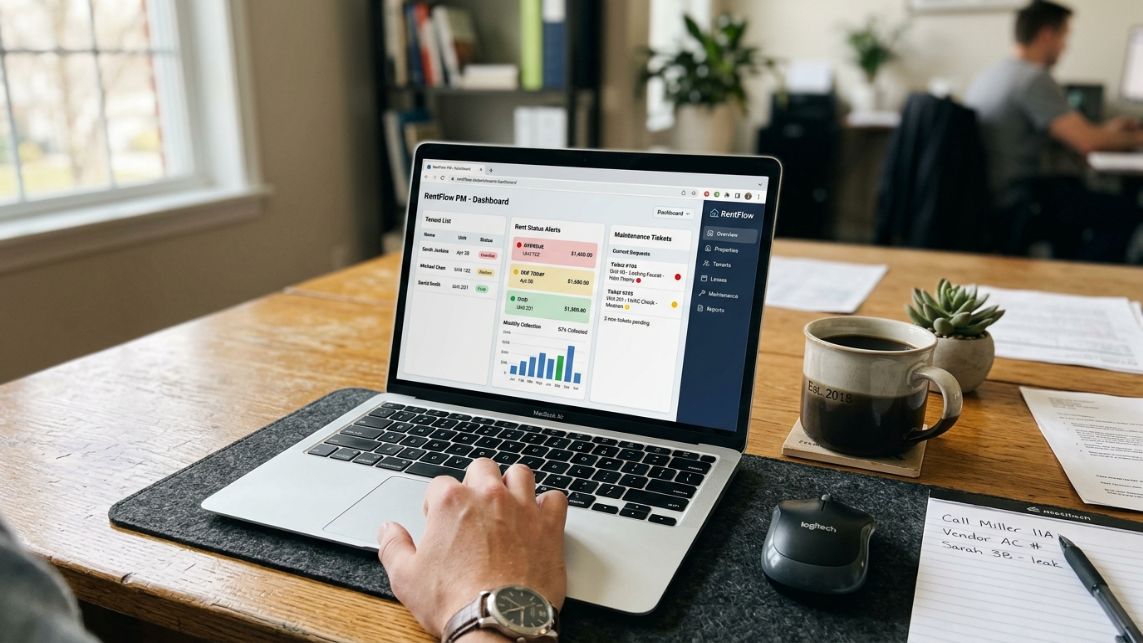
The central software platform where property managers track leases, tenants, financials, maintenance requests, and communications. AppFolio, Buildium, Yardi, and RentManager are common examples. Every other tool in your stack either integrates with or feeds data into your PMS.
Why it matters: Your PMS is the foundation. AI tools that can’t read from and write to your PMS create data silos and double entry. When evaluating any AI product, the first question should be: does it integrate directly with my PMS?
Common confusion: People sometimes call AI platforms a “PMS.” They’re not. AI layers sit on top of or beside the PMS, not in place of it.
PMS Integration / API
An API (Application Programming Interface) is the technical bridge that lets external tools connect to your PMS. A strong integration means the AI tool can read tenant data, create work orders, update records, and pull lease information without manual intervention.
Why it matters: “Integration” is one of the most overused words in property management software marketing. Some integrations are read-only (they can see data but can’t act on it). Others are bidirectional (they can both read and write). The difference determines whether your AI tool is a dashboard or an operational agent.
For a deeper breakdown of how PMS integrations work with AI tools, see the AppFolio AI integration glossary.
CRM (Customer Relationship Management)
In property management, a CRM tracks prospective tenants through the leasing funnel: initial inquiry, qualification, tour scheduling, application, and lease signing. Some PMS platforms include built-in CRM functionality. Others require a separate tool.
Why it matters: AI leasing tools need CRM data to personalize follow-ups, prioritize hot leads, and avoid contacting prospects who already signed elsewhere. Without CRM integration, an AI leasing assistant operates blind.
ILS (Internet Listing Service)
Platforms like Zillow, Apartments.com, and Rent.com where prospective tenants discover available units. ILS platforms generate leads that flow into your CRM or PMS.
Why it matters: Lead capture automation (covered below) depends on ILS integration. If your AI leasing tool can’t pull inquiries directly from Zillow or Apartments.com, someone on your team is still manually copying lead information into your system.
Automation Terms
Workflow Automation
Rule-based triggers that execute a predefined action when a condition is met. “If this happens, then do that.” No judgment, no learning, no adaptation. The same input always produces the same output.
Property management example: A new lease is signed. Workflow automation sends a welcome email, generates a move-in checklist, and creates a recurring rent charge in the PMS. No human touches it after initial setup.
Key distinction: Workflow automation handles repetitive, predictable tasks. It breaks down when situations require judgment, like deciding whether a tenant’s complaint warrants an emergency dispatch or a next-day visit.
Work Order Automation
The automatic creation, routing, and tracking of maintenance tasks within your PMS. When a tenant submits a request (via phone, text, or portal), the system creates a work order, categorizes it, and assigns it to the appropriate vendor or technician.
Property management example: A tenant texts “my dishwasher won’t drain.” The system creates a work order tagged “appliance, kitchen,” assigns it to your appliance vendor, and notifies the tenant of the expected service window.
For a detailed walkthrough of how work orders move from intake to closeout, the maintenance AI workflows guide covers every step.
Vendor Dispatch Automation
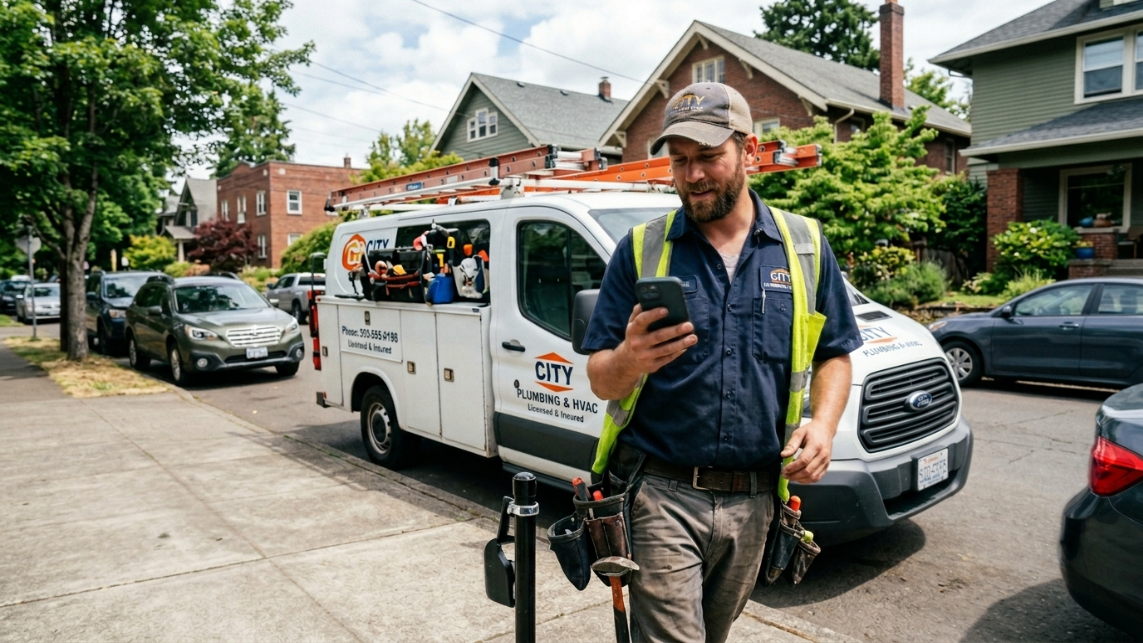
The automatic assignment of maintenance jobs to qualified vendors based on predefined rules: trade type, geographic zone, availability, and compliance status.
Why it matters: Manual vendor dispatch is one of the biggest time sinks in property management. A property manager with 300 units might coordinate with 15 to 20 vendors daily. Automating dispatch based on trade specialty and location eliminates phone tag and reduces time-to-resolution.
Lead Capture Automation
Pulling prospective tenant inquiries from ILS platforms (Zillow, Apartments.com) directly into your CRM or PMS without manual data entry. The system captures the lead’s contact information, unit interest, and inquiry details automatically.
Property management example: A prospect fills out a contact form on Apartments.com at 9 PM. Lead capture automation imports their information into your CRM, triggers an immediate response, and schedules a follow-up sequence. No one on your team needs to check the listing portal manually.
Property Management Automation vs AI vs Agentic AI (Key Differences)
Many vendors use the terms automation, AI, and agentic AI interchangeably, but they represent fundamentally different levels of capability.
Capability | Automation | AI | Agentic AI |
|---|---|---|---|
Uses rules | Yes | Sometimes | No |
Understands context | No | Yes | Yes |
Makes decisions | No | Yes | Yes |
Executes multi-step workflows | No | Limited | Yes |
Learns over time | No | Yes | Yes |
Requires human input | Always | Sometimes | Rarely |
Bottom Line
Automation = executes tasks
AI = interprets and decides
Agentic AI = executes full workflows independently
AI Terms
This is where the terminology gets both more powerful and more confusing. The difference between a chatbot and an AI agent is not a marketing distinction. It determines whether your technology handles a task or handles a workflow.
Artificial Intelligence (AI) in Property Management
The umbrella term for software that can interpret unstructured information, make decisions based on context, and improve its performance over time. In property management, AI applies to maintenance triage, leasing conversations, rent pricing, fraud detection, and more.
What AI is not: A set of if/then rules with a nicer interface. If the system can only do exactly what it was programmed to do in exactly the scenarios it was programmed for, it’s automation, not AI.
AI Agent
A software system that takes end-to-end operational actions on your behalf. Unlike a chatbot that suggests responses for a human to send, an AI agent reads the situation, decides on the appropriate action, and executes it.
Property management example: A tenant calls at 2 AM reporting a water leak. The AI agent answers the call, determines the severity through a series of questions, creates a work order in the PMS, dispatches an emergency plumber from the preferred vendor list, and texts the tenant confirmation of the appointment.
The difference between agents and simpler tools is significant. The leasing AI vs. chatbots guide breaks down the progression from basic chatbots to full AI agents.
Agentic AI
The 2026 term for AI that operates autonomously across multi-step workflows. Where a standard AI agent might handle one task (answering a phone call), agentic AI chains multiple tasks together: answering the call, triaging the issue, checking vendor compliance, dispatching the vendor, confirming the appointment with the tenant, and following up after completion.
According to a McKinsey analysis, organizations that have automated maintenance processes with agentic approaches have seen time savings of more than 30% on many workflows.
Why this term matters now: Industry analysts expect agentic AI to become mainstream in property management between 2026 and 2027. It represents the shift from “AI helps me do my job” to “AI does parts of my job while I oversee it.”
EliseAI’s 2026 executive survey found that 94% of multifamily operators are either implementing AI or planning to within the next 12 months. Among those who have deployed it, 77% report reduced operating expenses.
Generative AI
AI that creates new content: listing descriptions, email responses, marketing copy, lease summary letters. Large language models like ChatGPT power most generative AI features in property management tools today.
Current usage data: According to Buildium’s 2026 report, the most common AI applications are drafting property descriptions (30%), resident communications (29%), owner communications (24%), and marketing copy (23%). This represents the “shallow” end of AI adoption, useful but far from transformative.
Natural Language Processing (NLP)
The AI capability that allows software to understand human language, including misspellings, slang, and ambiguous descriptions. NLP is what lets a system understand that “my toilet keeps running” and “the commode won’t stop flushing” describe the same problem.
Why it matters for property management: Tenants don’t submit maintenance requests using standardized terminology. They text “theres water on my floor idk where its coming from” and expect someone to figure it out. NLP enables AI to classify, prioritize, and route these requests accurately.
Conversational AI / Voice AI
AI systems that interact with tenants and prospects via natural spoken or written conversation. Voice AI handles phone calls. Conversational AI also covers SMS and chat interactions.
Property management example: A prospect calls to ask about a two-bedroom unit. The voice AI answers, provides availability and pricing, asks qualifying questions, and schedules a tour, all in a natural-sounding phone conversation.
For a deep dive into how voice AI handles leasing calls and the ROI it generates, see the voice AI leasing calls guide.
AI-Native vs. AI-Bolted-On
This is one of the most important distinctions in the market right now, and practitioners are increasingly vocal about it.
AI-bolted-on means an existing PMS or software platform has added AI features on top of its legacy architecture. Think: a chatbot widget added to a portal, or a “suggested reply” button inside a messaging tool. The AI is a feature, not the foundation.
AI-native means the product was built from the ground up around AI capabilities. The entire architecture assumes AI will be reading data, making decisions, and taking actions.
As one industry analysis put it: “Operators are still drowning in guest messages at 11 PM, manually chasing reviews, and patching together workflows across five different tools. The problem isn’t AI. The problem is what kind of AI you’re getting.”
Practitioners on Reddit and LinkedIn consistently report that bolted-on AI features feel impressive in demos but underperform in production, particularly when handling edge cases or multi-step workflows.
Machine Learning (ML)
The subset of AI that identifies patterns in data and improves predictions over time without being explicitly reprogrammed. In property management, ML powers rent pricing optimization, predictive maintenance, and fraud detection.
Property management example: An ML model analyzes historical maintenance data across your portfolio and identifies that HVAC systems in buildings constructed before 1990 tend to fail in June. It flags those units for preventive service in May.
How to Evaluate Property Management AI Tools (Buyer Checklist)
When evaluating property management system automation AI, focus less on marketing claims and more on functional capability across the workflow stack.
Key Evaluation Questions
Does the system integrate bidirectionally with your PMS?
Can it create and update work orders automatically?
Does it support multi-step workflows or only single actions?
How does it handle ambiguous tenant messages?
Are there human-in-the-loop compliance checkpoints?
Can it operate across leasing + maintenance workflows?
Red Flags
“AI-powered” with no workflow execution ability
Read-only integrations
No explanation of decision logic
No Fair Housing safeguards
No vendor compliance checks
Operational Terms
These are the terms where property management system automation AI moves from theory into the daily work of running properties. This section matters most for operations staff evaluating tools.
Maintenance Triage
The process of classifying incoming maintenance requests by urgency and type. Triage determines whether an issue is an emergency (burst pipe, gas leak), urgent (no hot water in winter), or routine (squeaky cabinet hinge).
Why AI changes triage: Manual triage depends on whoever reads the request first, which might be a leasing agent with no maintenance background, or it might be nobody because the request came in at midnight. AI triage is consistent, immediate, and available 24/7.
For a complete breakdown of how AI handles emergency classification, the emergency maintenance triage guide covers detection methods and escalation protocols.
Emergency Detection
The AI capability to identify habitability and safety threats in tenant communications, even when the tenant doesn’t explicitly say “emergency.” A message like “I smell something weird near the stove and my head hurts” contains indicators of a potential gas leak that require immediate escalation.
Why it matters: Missed emergencies create liability exposure, property damage, and tenant safety risks. AI systems trained on property management scenarios can flag emergencies that an untrained after-hours answering service might miss.
First-Trip Completion (FTC)
The percentage of maintenance issues resolved on the vendor’s first visit, without requiring a return trip. This metric directly impacts tenant satisfaction, vendor costs, and time-to-resolution.
Why it belongs in this glossary: FTC improves when the AI collects detailed diagnostic information during intake (photos, videos, troubleshooting results) and passes that information to the vendor before they arrive. A plumber who knows it’s a specific faucet model with a cartridge issue brings the right part the first time.
For benchmarks on FTC and other maintenance metrics, the maintenance AI KPIs guide provides industry data.
Tenant Troubleshooting
AI-guided walkthroughs that help tenants resolve simple issues themselves before a vendor is dispatched. Checking a tripped breaker, resetting a garbage disposal, adjusting a thermostat.
The ROI case: Data from ViziSmart suggests that up to 40% of maintenance tickets are not actual breakage but user error. If an agentic system can guide a resident through checking a tripped GFCI outlet before dispatching an electrician, that’s a $150 to $300 truck roll avoided.
Predictive Maintenance
Using historical data, sensor readings, and ML models to anticipate equipment failures before they happen. Instead of waiting for the HVAC to break in July, predictive maintenance flags units likely to fail and schedules preventive service.
Reality check: True predictive maintenance requires significant data history and often IoT sensors. Most property management AI in 2026 is still reactive (responding to reported issues) rather than genuinely predictive. Claims of “predictive maintenance” should be evaluated carefully.
Work Order Lifecycle
The complete chain from a maintenance request to resolution: intake, triage, emergency detection, work order creation, vendor compliance check, dispatch, execution, follow-up, and closeout.
Why the full lifecycle matters: Many automation tools handle only one or two steps. A tool that auto-creates work orders but doesn’t follow up with the vendor or confirm completion with the tenant leaves gaps that staff must fill manually.
After-Hours Coverage / 24/7 Answering
Round-the-clock intake and response for tenant maintenance requests and leasing inquiries. Traditionally handled by call centers, increasingly handled by AI voice and text systems.
Why it matters: Maintenance emergencies don’t wait for business hours. Leasing prospects don’t either. Organizations using AI for 24/7 coverage report faster response times and higher lead-to-lease conversion because prospects get answers immediately instead of waiting until morning.
For a practical comparison of AI coverage versus traditional call centers, the maintenance AI vs. call center guide covers costs, response quality, and scalability.
Compliance and Governance Terms
Most glossaries skip this section entirely. That’s a mistake. Compliance is where property management system automation AI creates the most risk if implemented carelessly, and the most protection if implemented well.
Human-in-the-Loop
A system design principle where humans review and approve AI decisions at critical points. The AI handles routine tasks autonomously, but escalates to a human when the situation involves legal liability, ambiguity, or high-stakes judgment.
Property management examples: An AI drafts a lease violation notice but requires a property manager to review and send it. An AI recommends denying an application based on screening criteria but flags it for human review before the denial letter goes out.
Why it matters: Full autonomy sounds efficient. But in property management, a single automated message that violates Fair Housing law can trigger a federal complaint. Human-in-the-loop isn’t a limitation of AI. It’s a feature.
Fair Housing Compliance (AI Context)
The requirement that all automated communications with prospective and current tenants comply with the Fair Housing Act and state-level anti-discrimination laws. This applies to AI-generated listing descriptions, chatbot responses, email templates, and phone conversations.
Practitioners on review sites flag this consistently: AI-generated communications still require human review before sending, particularly because Fair Housing language needs a careful read before any automated communication goes to a prospective tenant.
For a complete treatment of how AI leasing tools intersect with Fair Housing requirements, the Fair Housing compliance glossary is essential reading.
Vendor Compliance Gate
An automated checkpoint that blocks work order dispatch to vendors with expired insurance certificates (COI), licenses, or other required credentials. The system checks compliance status before assigning a job and routes to an alternative vendor if the primary one is non-compliant.
Why this term matters: If you dispatch a vendor with expired liability insurance and that vendor damages a tenant’s property, your company bears the liability. A vendor compliance gate automates what property managers otherwise track in spreadsheets.
ROI and Measurement Terms
NOI (Net Operating Income)
The core financial metric that property management AI aims to improve. NOI equals total revenue minus operating expenses. AI can improve NOI by reducing maintenance costs (fewer unnecessary dispatch calls, faster resolution), increasing revenue (better lead-to-lease conversion, optimized rent pricing), and lowering payroll costs (fewer manual tasks per unit managed).
The growth gap: According to AppFolio’s 2026 Benchmark Report, organizations using AI in core workflows expect portfolio growth nearing 31% this year, compared to just 12% for firms that haven’t incorporated AI.
Lead-to-Lease Conversion
The percentage of prospective tenant inquiries that result in signed leases. This is the primary metric for evaluating leasing AI effectiveness.
Benchmark data: AppFolio reported that early users of its Realm-X Leasing Performer achieved 73% higher lead-to-showing conversion rates. Among operators using EliseAI, 85% reported increased lead-to-lease conversion.
However, a practitioner review offered a more grounded take: as of early 2026, AI leasing tools handle straightforward queries well but struggle with complex cross-property comparisons involving more than two data dimensions. Treat them as time-savers, not analyst replacements.
Time-to-Resolution
The elapsed time from when a maintenance request is submitted to when the issue is confirmed resolved. AI reduces time-to-resolution by accelerating triage, automating dispatch, and enabling tenant self-troubleshooting for simple issues.
How to Evaluate AI Claims
With the terminology now defined, here’s how to apply it when vendors pitch you on property management system automation AI.
Ask which layer you’re buying. Is it rule-based automation with an AI label? A generative AI feature bolted onto existing software? Or a genuinely agentic system that executes multi-step workflows? The answer determines whether you’re saving minutes or hours.
Request a live demo with ambiguous scenarios. Don’t let vendors control the script. Give the system a misspelled maintenance request, a prospect asking about two properties simultaneously, or an after-hours emergency with incomplete information. How it handles ambiguity reveals whether it’s truly intelligent or just following a decision tree.
Verify PMS integration depth. Can the tool read from and write to your PMS? Can it create work orders, update statuses, and log notes? Or does it just display information from your PMS without the ability to act on it? Read-only integration is a reporting tool, not an operational agent.
Ask about compliance guardrails. Does the system have human-in-the-loop checkpoints for Fair Housing-sensitive communications? Does it include vendor compliance gates? If the vendor can’t answer these questions specifically, the product wasn’t built for the regulatory reality of property management.
Ground your expectations. Remember that 8% statistic. Most of the industry hasn’t fully automated anything yet. A vendor promising instant transformation is selling you a future that doesn’t match where the technology reliably operates today. Start with one workflow, measure the results, and expand from there.
To see how these terms work together in a real AI system built for property managers, book a demo with Haven.
Frequently Asked Questions
What is the difference between property management automation and AI?
Automation follows fixed rules you define: if a trigger occurs, a specific action executes. AI reads context, interprets unstructured inputs (like tenant messages), makes decisions, and can adapt its behavior based on outcomes. Automation handles the predictable. AI handles the variable.
What does “agentic AI” mean in property management?
Agentic AI refers to systems that autonomously execute multi-step workflows. Instead of handling a single task (like answering a phone call), agentic AI chains actions together: answering the call, triaging the issue, creating a work order, checking vendor compliance, dispatching the vendor, and following up with the tenant. It operates proactively rather than waiting for human instructions at each step.
Is AI in property management actually reducing costs?
The data says yes, for those who implement it deeply. EliseAI reports that 77% of operators who deployed AI saw reduced operating expenses. AppFolio data shows AI adopters expect nearly 31% portfolio growth versus 12% for non-adopters. But shallow adoption (using ChatGPT to draft emails) produces shallow results. The ROI comes from automating full workflows, not individual tasks.
What is the biggest risk of using AI in property management?
Fair Housing compliance. AI-generated communications can inadvertently use discriminatory language or apply screening criteria in biased ways. Any AI tool that communicates with prospective tenants needs human-in-the-loop review at critical points. A secondary risk is AI-powered fraud: according to screening vendor Celeri, approximately 1 in 10 rental applicants now submits fraudulent documents, many generated using the same AI tools driving efficiency elsewhere.
What does “AI-native” mean, and why does it matter?
AI-native means the product was architecturally designed around AI from the start. AI-bolted-on means AI features were added to an existing legacy platform. The practical difference shows up in edge cases and complex workflows. Native AI systems handle ambiguity and multi-step decisions better because the entire product infrastructure supports intelligent processing, not just a widget layer on top.
How do I know if a property management AI tool actually integrates with my PMS?
Ask specifically whether the integration is read-only or bidirectional. A bidirectional integration means the AI can both pull data from your PMS (tenant records, lease terms, vendor lists) and push data back (creating work orders, updating statuses, logging notes). If the vendor only demonstrates dashboards and reports, the integration may be too shallow to replace manual work.
What percentage of property managers are using AI in 2026?
According to Buildium’s 2026 industry report, 58% of property management companies are using AI tools in some capacity. However, only 8% have fully automated any single workflow. Most current usage centers on generative AI for content creation, such as drafting property descriptions and tenant communications. Deeper, operational AI adoption is still in early stages.
Can AI handle maintenance emergencies after hours?
Yes, and this is one of the strongest use cases. AI voice and text systems can answer tenant calls at 2 AM, ask diagnostic questions to determine severity, classify the issue as an emergency or routine request, and dispatch an emergency vendor if needed. This replaces traditional after-hours call centers with faster, more consistent triage that operates 24/7 without fatigue or staffing gaps.