AI vs BPO Call Center (2026): Costs, Speed, Hybrid Wins
AI vs BPO Call Center in 2026: see costs, ROI, and when hybrid wins. Cut 70–80% of routine calls with 24/7 AI and PMS integration. Compare options.

TL;DR
A BPO call center outsources your tenant calls to third-party human agents, typically costing $5.50 to $8.50 per inbound contact. An AI call center uses conversational AI to handle those same calls instantly for roughly $0.50 per interaction. For structured property management workflows like maintenance intake and leasing inquiries, AI wins on cost, speed, and consistency. The strongest setup in 2026 is a hybrid model where AI handles 70 to 80% of routine volume and humans manage the complex exceptions.
If your property management company receives a high volume of routine tenant calls, AI is usually the better choice because it answers instantly, operates 24/7, integrates directly with property management software, and costs roughly 75–90% less per interaction than a traditional BPO call center. However, companies that frequently deal with legal disputes, sensitive resident issues, or highly customized conversations should adopt a hybrid model where AI handles routine requests while experienced human agents manage complex situations.
This is now the preferred operating model for most growing property management companies in 2026.
What Is a BPO Call Center?
BPO stands for business process outsourcing. A BPO call center is a team of third-party agents hired to handle incoming and outgoing calls on behalf of another business. You’re not employing these people directly. You’re paying a vendor to staff, train, and manage them.
A common misconception is that “BPO” and “call center” mean the same thing. They don’t. BPO encompasses a broader range of outsourced activities, including back-office tasks like accounting, HR, and data entry. A call center is one specific function within BPO, focused on customer-facing communication.
In property management, BPO call centers typically handle after-hours answering, overflow calls during busy periods, and basic maintenance request intake. The agent picks up, takes the tenant’s information, logs a message, and passes it along to your team.
BPO Geographic Models and What They Cost
Pricing depends heavily on where the agents sit:
Onshore (US-based): $29.40 to $42 per hour. Agents speak native English and understand local context, but the cost is steep.
Nearshore (Latin America): $20 to $30 per hour. A middle ground on price and cultural alignment.
Offshore (Philippines/India): $8 to $16 per hour. The cheapest option, and the most common for property management answering services.
On a per-contact basis, a typical inbound voice call (averaging 5 minutes) costs $5.50 to $8.50 through a BPO provider. Monthly per-agent rates fall between $1,200 and $4,000.
But the quoted rate is only part of the picture. Indirect costs like benefits, taxes, training, turnover, idle time, and management overhead add 40 to 60% on top of base BPO wages. According to operational analyses, the per-agent rate represents only 45 to 55% of the true cost.
Turnover is a particularly painful hidden expense. BPO call centers experience 30 to 45% annual turnover industry-wide, with offshore operations in the Philippines and India often running 35 to 50%. For a 200-agent operation with 40% annual turnover, that translates to roughly $465,600 per year in turnover-related costs alone, covering recruiting, onboarding, and the productivity gap while new agents ramp up.
What Is an AI Call Center?
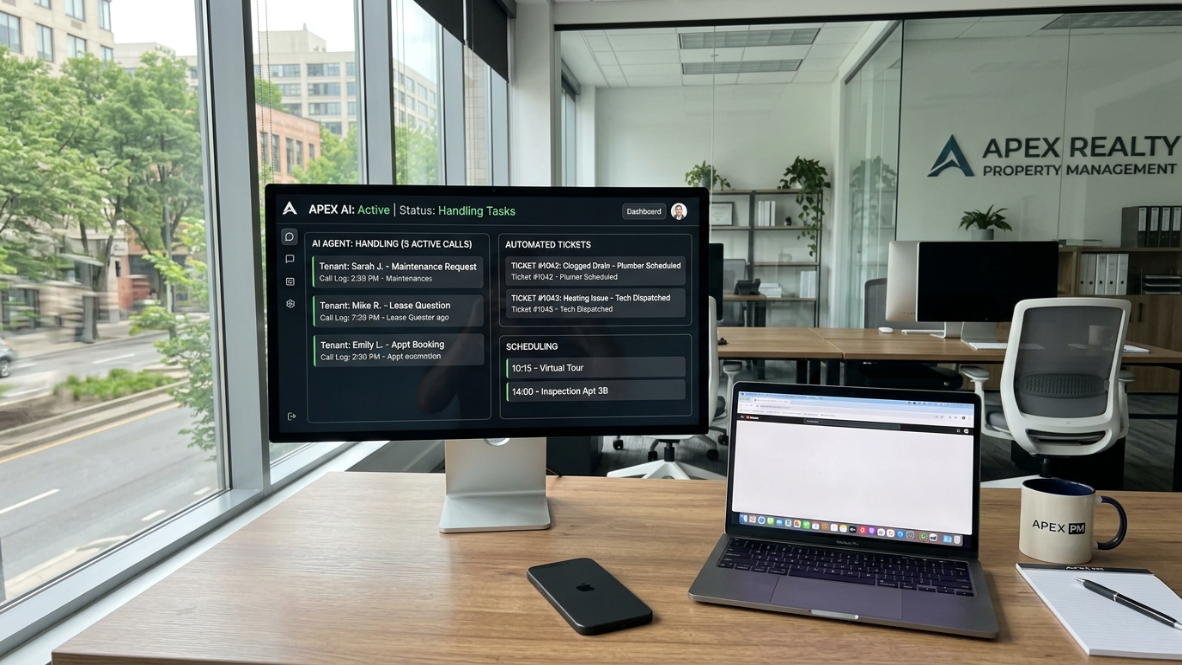
An AI call center uses conversational artificial intelligence to answer calls, automate workflows, and complete structured interactions without human agents in the loop. No hold times. No shift schedules. No queue buildup.
This is not the clunky IVR system that makes you press 1 for billing and 2 for support. Modern voice AI conducts actual conversations, understanding natural speech, asking follow-up questions, and taking action based on the answers.
In property management specifically, AI call centers handle maintenance intake and triage, leasing inquiry capture, tenant FAQ deflection, tour scheduling, vendor dispatch, and emergency maintenance triage. The AI doesn’t just take a message. It identifies whether the issue is urgent, creates a work order in the property management system, and can dispatch a vendor from the preferred list, all during the same call.
A critical technical milestone arrived in April 2026: conversational AI crossed the 200-millisecond human latency threshold. This means AI agents can now interrupt, respond, and speak in real time, matching the natural cadence of human conversation. That milestone removed the last major user experience barrier that protected legacy BPO models. The “robotic pause” that made earlier AI obvious is gone.
AI Call Center Cost Structure
AI call centers price differently than BPO. Instead of hourly agent rates, you’re looking at:
Per-interaction: $0.25 to $0.70 depending on complexity, with an average around $0.50. Compare that to $6.00 for the same interaction handled by a human agent. That’s a 12x cost advantage per ticket before factoring in 24/7 availability without overtime premiums.
Per-minute (voice AI): Purpose-built voice AI operates at $0.02 to $0.05 per minute of inference cost, versus $1.50 to $2.00 per minute for an onshore Tier-1 BPO agent.
Subscription: Some providers charge monthly based on unit count or call volume.
For property managers exploring what this looks like in practice, Haven’s AI property management software offers purpose-built maintenance and leasing AI agents that operate across phone, SMS, and email.
AI vs BPO Call Center: Key Differences
Here’s how the two models compare across the dimensions that matter most for property management operations.
Dimension | BPO Call Center | AI Call Center |
|---|---|---|
Cost per interaction | $5.50 – $8.50 | $0.25 – $0.70 |
Availability | 24/7 possible, but requires shift staffing and premium night/weekend rates | True 24/7 with instant answering, no shift changes |
Scalability | Requires hiring, training, and ramp-up time (weeks to months) | Scales instantly without hiring or queue buildup |
Consistency | Varies by agent, shift, and turnover cycle | Does not deviate from defined standards |
Complexity handling | Humans excel at empathy, nuance, and edge cases | Handles structured tasks; struggles with ambiguous situations |
PMS integration | Agents log notes manually or through separate systems | Can write directly to AppFolio, Yardi, and other PMS platforms |
Domain knowledge | Depends on training quality and agent tenure | Trained specifically on property management workflows |
Data and analytics | Limited reporting, often delayed | Real-time conversation data and trend analysis |
The consistency gap deserves special attention. Even with strong management, BPO quality fluctuates. Agent A might handle a maintenance call perfectly. Agent B, hired two weeks ago to replace someone who quit, might miss the signs of a genuine emergency. AI doesn’t have bad days, doesn’t forget its training, and doesn’t quit after three months.
Which Option Is Best for Different Property Management Companies?
Different portfolio sizes benefit from different support models.
Portfolio Size | Recommended Solution |
|---|---|
Under 100 units | Small BPO or hybrid answering service |
100–500 units | AI-first with human escalation |
500–2,000 units | Hybrid AI + in-house team |
2,000+ units | Enterprise AI platform with specialized human teams |
AI vs BPO Call Center at a Glance
If your priority is... | Best Choice |
|---|---|
Lowest operating cost | AI |
24/7 answering | AI |
Maintenance intake | AI |
Leasing inquiries | AI |
Vendor dispatch | AI |
Emotional conversations | BPO |
Legal disputes | BPO |
Owner relationship management | BPO |
Fair Housing edge cases | Human oversight |
Rapid portfolio growth | Hybrid |
Small property portfolio | Depends on volume |
Cost Comparison: The Full Picture
The headline numbers favor AI dramatically. But good decision-making requires looking at the complete cost picture, including some important caveats.
BPO: What You’re Actually Paying
A property management company using an offshore BPO for after-hours answering might see a quoted rate of $10 per hour. That sounds cheap. But factor in:
Training new agents every time someone leaves (and at 35 to 50% offshore turnover, that’s constant)
Quality assurance monitoring
Management overhead to coordinate with the BPO vendor
Rework when agents log incorrect information or misclassify emergencies
Idle time during low-call-volume periods (you’re still paying)
The true cost often runs 40 to 60% higher than the base rate. For context on how this math plays out for property managers specifically, this guide on replacing property management call centers walks through the ROI calculation in detail.
AI: Where the Savings Come From
AI-powered BPO providers are delivering support at 75 to 85% lower cost than traditional models, with quality metrics that match or beat human agents on structured tasks. The savings compound because AI eliminates overtime premiums, turnover costs, idle time, and the management layer required to supervise human agents.
ROI comes from multiple areas: hard cost savings from replacing expensive call centers, reduced staff overtime, faster vacancy filling (which reduces lost rent), and improved tenant retention. Some property management companies have reported saving property managers an average of five hours per week on communication tasks.
The Gartner Caveat: AI Costs May Not Stay This Low for Everyone
Gartner projects that by 2026, conversational AI deployments within contact centers will reduce agent labor costs by $80 billion (a four-year cumulative figure, not annual, a nuance most articles skip).
But there’s a counterpoint worth knowing. Gartner also predicts that by 2030, the cost per resolution for generative AI could exceed $3, potentially higher than many offshore human agents. Rising data center costs, a shift from subsidized pricing to profitability for AI vendors, and increasingly complex use cases that consume more tokens will push costs up.
Here’s why that matters less for property management than it sounds: that prediction applies most directly to general-purpose generative AI deployed against complex, open-ended interactions. For purpose-built AI agents handling structured workflows like maintenance intake, work order creation, and leasing inquiry capture, the cost trajectory looks different. These are defined, repeatable processes, not open-ended conversations that spiral through hundreds of AI reasoning steps. Property management maintenance triage is exactly the kind of structured workflow where purpose-built AI retains its cost advantage.
For a deeper breakdown of the financial case, see this analysis of AI property management ROI.
xample Cost Comparison
A property management company handling 5,000 tenant calls each month could expect dramatically different annual operating costs depending on the support model.
Support Model | Approximate Cost per Call | Estimated Monthly Cost | Estimated Annual Cost |
|---|---|---|---|
Traditional BPO | $6.00 | $30,000 | $360,000 |
AI Voice Agent | $0.50 | $2,500 | $30,000 |
Hybrid (80% AI) | ~$1.60 | ~$8,000 | ~$96,000 |
Actual costs vary based on call duration, workflow complexity, and software integrations.
Decision Framework: Should You Choose AI or a BPO?
Choose AI if you:
Receive repetitive maintenance calls
Miss after-hours leasing inquiries
Want lower operating costs
Need faster response times
Want automatic work order creation
Need 24/7 availability
Choose a BPO if you:
Handle mostly complex conversations
Have low monthly call volume
Need live negotiation or dispute resolution
Require extensive human judgment
Choose a Hybrid Model if you:
Manage more than one property
Want to scale without hiring
Need both automation and human expertise
Expect continued portfolio growth
When AI Wins
After-Hours Coverage
Studies show 49 to 60% of calls to multifamily properties go unanswered, and 85% of those callers never call back. Each missed leasing call costs roughly $1,000 in lost rental income. AI eliminates this problem entirely. It answers every call, at any hour, with zero wait time.
The difference between a BPO handling your after-hours answering and an AI handling it isn’t just cost. It’s what happens on the call. A BPO agent takes a message. An AI agent triages the issue, creates the work order, and dispatches the vendor.
Maintenance Intake and Triage
This is where AI’s advantage over BPO becomes most obvious. Property Meld’s data shows that 40% of issues residents report as emergencies aren’t actually emergencies. A tenant calling at 2 AM about a “flooded bathroom” might have a slow drip under the sink. Or they might have a burst pipe causing real water damage.
BPO agents, especially offshore ones cycling through high turnover, can’t consistently make that distinction. Practitioners on Reddit’s r/PropertyManagement forum are blunt about this: they want “property managers or subject matter experts and not call center agents.” The complaint is that BPO reps can take a message but can’t triage a maintenance issue correctly. AI trained specifically on property management workflows delivers more consistent domain knowledge than a rotating cast of agents who handled insurance claims last week and property calls this week.
Data shows average maintenance response time drops from 4.6 days to under 18 hours within 30 days of implementing automated systems. That acceleration directly impacts tenant satisfaction and retention.
Leasing Inquiry Capture
A 2025 Salesforce report found that 83% of customers expect an immediate response when they contact a brand. For leasing, “immediate” means the difference between capturing a prospect and losing them to the next listing. AI responds within seconds, qualifies the lead, and schedules a tour, all without a human touching the interaction.
High-Volume FAQ Deflection
Most contact centers find that 70 to 80% of their volume is routine. “When is rent due?” “Where do I pay?” “Is my maintenance request being worked on?” AI handles these effortlessly, freeing property managers from repetitive tasks. This is where tools like an AI leasing assistant or AI maintenance coordinator prove their value.
Common Workflows AI Can Fully Automate

For structured property management processes, AI can complete the entire workflow without transferring the call to a human.
Examples include:
Maintenance request intake
Emergency triage
Vendor dispatch
Tour scheduling
Lease inquiry qualification
Rent payment questions
Office hours and property FAQs
Appointment reminders
Resident follow-ups
Work order status updates
When BPO Still Makes Sense
AI isn’t the right tool for every interaction. Humans remain essential for:
Complex escalations that require judgment, negotiation, or creative problem-solving. A lease dispute involving competing claims about property damage needs a person.
Emotionally sensitive situations where a tenant is genuinely distressed, dealing with domestic issues, or navigating a crisis. Empathy isn’t a workflow.
Regulatory-heavy conversations requiring specific human disclosures or where Fair Housing compliance demands nuanced handling that goes beyond scripted guardrails.
Relationship-critical moments like owner communications, investor calls, or negotiations where the human connection carries business value.
If your call volume is small, your interactions are highly variable, and most of your calls require judgment rather than process execution, a BPO with well-trained agents might still be the better fit. But for most property management operations at scale, those interactions represent the minority of total volume.
Situations Where Human Agents Still Deliver Better Results
Even the best conversational AI should hand off interactions involving:
Fair Housing complaints
Threats of legal action
Resident safety concerns
Domestic violence reports
Insurance negotiations
Lease termination disputes
Owner financial discussions
Eviction conversations
The Hybrid Model: Why It’s the 2026 Consensus
Every credible analysis of the AI vs BPO call center question arrives at the same conclusion: the future is hybrid.
AI handles Tier 1, the 70 to 80% of volume that’s routine. Humans handle Tier 2 and Tier 3, the escalations that require judgment, empathy, or authority.
In property management terms, that looks like this:
AI takes the 2 AM call. Identifies the issue. Asks the right questions. Determines whether it’s a true emergency or something that can wait until morning. Creates the work order in the PMS. Dispatches the emergency vendor if needed. Sends the tenant a confirmation.
The property manager handles the insurance claim the next morning. Reviews the AI’s documentation. Manages the relationship with the difficult tenant. Negotiates with the vendor on pricing. Handles the owner communication.
Forrester predicts that 30% of enterprises will create parallel AI functions that mirror human service roles by end of 2026, including AI agent managers, AI operations teams, escalation specialists, and conversation designers.
A Filipino BPO worker sparked a telling discussion on Reddit with this prediction: “I keep saying this… AI will replace the BPO industry.” At his previous job, without AI, he handled 30 calls during an eight-hour shift. Now, with AI augmenting the process, he handles the same volume before lunch. The BPO industry itself is being reshaped, not eliminated, by AI.
For property management companies growing their portfolios, this hybrid approach means you can scale operations with AI handling the volume while keeping a lean human team for the work that genuinely requires people.
What Property Managers Should Evaluate
If you’re comparing AI vs BPO call center options for your portfolio, these are the evaluation criteria that separate good solutions from expensive mistakes.
PMS Integration
This is non-negotiable. If the AI can’t write directly to your property management system (AppFolio, Yardi, Buildium, or others), every interaction generates manual data re-entry. That defeats the purpose. Ask whether the AI creates work orders, assigns tickets, and logs notes automatically. For AppFolio users specifically, this guide to AI work order creation covers what to look for.
Emergency Triage Accuracy
How well does the AI distinguish between a dripping faucet and a burst pipe? Between a sticking lock and a break-in? Triage accuracy directly impacts resident safety and your liability exposure. Ask for accuracy metrics and error rates on emergency classification.
Multichannel Support
Tenants don’t just call. They text. They email. They submit requests through portals. The best AI solutions handle phone, SMS, and email from a unified system, maintaining conversation continuity across channels.
Conversation Memory
Can the AI reference a previous interaction? If a tenant called Monday about a leak and calls back Wednesday for an update, the AI should know the context without making the tenant repeat everything.
Vendor Dispatch Capability
Can the AI actually dispatch from your preferred vendor list, or does it just log a request for your team to act on later? The difference between “message taken” and “vendor dispatched” is the difference between automation and just a fancier answering service.
Fair Housing Compliance
AI that handles leasing inquiries must have Fair Housing compliance guardrails built in. It should never make statements that could be construed as discriminatory, and it should treat every prospect identically regardless of protected class characteristics.
Book a demo with Haven to see how purpose-built AI agents handle these workflows for property management teams.
How to Transition from a BPO to AI
Most successful property managers don't replace their entire call center overnight.
A lower-risk migration usually follows these stages:
Phase 1
Deploy AI only for after-hours calls.
Phase 2
Add maintenance intake.
Phase 3
Automate leasing inquiries.
Phase 4
Enable vendor dispatch.
Phase 5
Expand AI to handle resident FAQs and outbound follow-up.
Complex situations continue routing to experienced property managers throughout the transition.
Common Mistakes When Evaluating AI Call Centers
Avoid these common buying mistakes:
Comparing hourly BPO pricing with per-minute AI pricing
Ignoring integration costs
Failing to test emergency triage
Choosing general-purpose AI instead of property-management AI
Measuring only labor savings instead of total operational ROI
Forgetting Fair Housing compliance requirements
Future Outlook: AI vs BPO Beyond 2026
Industry trends suggest AI will continue handling a larger share of structured customer interactions over the next several years.
Expected developments include:
Better multilingual conversations
More autonomous maintenance coordination
Predictive maintenance recommendations
Voice agents with long-term memory
Deeper property management software integrations
Increased human oversight for legal and compliance-sensitive situations
Rather than replacing people entirely, AI is expected to reduce repetitive administrative work while allowing property managers to focus on resident relationships and portfolio growth.
FAQ
What does BPO stand for in call centers?
BPO stands for business process outsourcing. In the call center context, it means hiring a third-party company to staff and manage agents who handle your inbound and outbound calls. The agents work for the BPO vendor, not for you directly.
Is AI cheaper than a BPO call center?
For structured, repetitive interactions, yes. AI averages about $0.50 per interaction compared to $5.50 to $8.50 for a BPO voice contact. That’s roughly a 10 to 12x cost advantage. When you add BPO hidden costs (turnover, overhead, idle time), the gap widens further. However, Gartner warns that general-purpose GenAI costs may rise by 2030. Purpose-built AI for specific workflows like property management retains the strongest cost advantage.
Can AI fully replace a property management call center?
Not entirely. AI handles 70 to 80% of routine volume effectively: maintenance intake, leasing inquiries, FAQ deflection, tour scheduling, and vendor dispatch. But complex escalations, emotionally sensitive conversations, and situations requiring human judgment still need people. The consensus in 2026 is a hybrid model, not full replacement.
What is the hybrid AI-BPO model?
A hybrid model uses AI to handle Tier 1 interactions (routine, structured, high-volume tasks) while a smaller team of trained human agents manages Tier 2 and Tier 3 escalations. This approach captures 75 to 85% of AI’s cost savings while preserving human quality for the interactions that need it.
How quickly can AI reduce call center costs?
Property management companies have reported measurable results within 30 days of implementation, including maintenance response times dropping from 4.6 days to under 18 hours. Cost reductions of 15 to 65% have been documented depending on the scope of replacement. The ROI typically comes faster for after-hours and maintenance workflows because those are the highest-volume, most structured interactions.
How has AI adoption changed in property management?
AI adoption in property management nearly doubled from 21% in 2024 to 34% in 2025. Property managers spend roughly 40% of their time on tenant communications, making this one of the most obvious automation opportunities in the industry. Gitnux reports maintenance expenses dropping 28% through AI implementation.
Does voice AI still sound robotic?
Not anymore. As of April 2026, conversational AI crossed the 200-millisecond human latency threshold, meaning AI agents respond with the same natural timing as human speakers. They can interrupt, pause, and adjust tone in real time. The “robotic voice” objection that was valid even two years ago no longer applies to current-generation voice AI systems.