AI Success Stories Small Operators: 2026 Metrics Guide
Explore AI success stories small operators with 2026-ready metrics, ROI timelines, and pitfalls. Learn where to start and measure wins.

TL;DR: What Does AI Success Look Like for a Small Property Management Company?
For a small property management operator, AI success is usually measured by faster response times, fewer manual tasks, more leads converted, faster maintenance resolution, and more units managed without adding equivalent administrative workload. Industry data shows AI adoption is accelerating, but full workflow automation is still early: Buildium reports that AI use among property management companies increased from 20% in 2024 to 58% in 2025, while only 8% reported fully automating any process. AppFolio's 2026 benchmark found that 44% of property management professionals use AI in their roles.
For operators managing roughly 50 to 500 units, the best starting point is usually one measurable workflow, such as leasing follow-up, maintenance intake, after-hours communication, or vendor coordination. Measure the baseline before implementation, compare results for 60 to 90 days, and expand only after the first workflow demonstrates measurable operational or financial value.
The most useful AI success metrics are speed-to-lead, lead-to-showing conversion, maintenance response time, request-to-resolution time, hours saved, cost per automated task, vacancy days avoided, and units managed per employee.
2026 AI Property Management Benchmarks at a Glance
Metric | 2026 benchmark or finding | What it means for a small operator |
|---|---|---|
Property management companies using AI | 58% | AI adoption is becoming mainstream, but adoption does not necessarily mean automation |
Companies fully automating a process | 8% | There is still a significant gap between experimenting with AI and automating real workflows |
Property management professionals using AI | 44% | AI use is already established across the industry |
Operators unable to rely on legacy PMS AI | 78% | Reliability and workflow execution remain major adoption barriers |
AI adopters planning to increase headcount | 34% | AI is often being used to increase capacity rather than simply eliminate jobs |
Non-AI users planning to increase headcount | 25% | AI adopters show a stronger tendency toward staffing for growth |
Expected portfolio growth among broad AI adopters | 31% | AI adoption correlates with more aggressive growth expectations |
Expected portfolio growth among other firms | 12% | AI leaders report substantially higher growth expectations |
Source note: Buildium's 2026 industry research reports 58% AI adoption and 8% full process automation. AppFolio's 2026 benchmark reports 44% AI use, a 78% reliability gap for legacy PMS AI, 34% planned headcount increases among AI adopters, 25% among non-users, and 31% versus 12% expected portfolio growth. These figures come from different surveys and should not be treated as directly comparable populations.
Most published AI success stories in property management feature portfolios of 5,000 or 50,000 units. They’re impressive. They’re also irrelevant to the operator managing 200 doors with a three-person team who needs to know whether a $300/month AI tool will actually move the needle.
This glossary exists to fix that gap. Every term below is defined plainly, then connected to current industry research, reported AI outcomes, and small-operator scenarios. Because much of the published research covers the broader property management market rather than specifically 50- to 500-unit firms, this guide distinguishes between industry benchmarks, vendor-reported results, practitioner examples, and illustrative calculations.
If you’re exploring what AI tools actually do at your scale, Haven’s AI software overview is a good starting point.
How These AI Success Benchmarks Were Selected
The benchmarks in this guide come from a combination of 2026 property management industry surveys, vendor-reported performance data, practitioner examples, and illustrative calculations.
Industry survey figures are identified by their original source and should be interpreted according to that source's methodology. Vendor-reported performance figures describe outcomes reported by that vendor's customers and are not necessarily independent industry averages. Practitioner examples illustrate what may be possible at smaller portfolio sizes but should not be treated as statistically representative.
Where this guide calculates potential savings, the figures are illustrative scenarios rather than guarantees. Actual results depend on portfolio size, vacancy rates, maintenance volume, labor costs, market conditions, software pricing, and the quality of the underlying property data.
The most useful way to apply these benchmarks is to establish a pre-AI baseline for your own operation, implement one workflow, and compare the same metrics after 30, 60, and 90 days.
What Counts as an AI Success Story for a Small Operator?
An AI success story in property management is not simply using ChatGPT, adding a chatbot, or purchasing software with an AI label. A meaningful success story occurs when an AI-enabled workflow produces a measurable improvement in an operational or financial outcome.
For a small operator, that outcome can include:
Faster leasing response times
More leads converted into tours
Fewer missed after-hours calls
Faster maintenance request resolution
Less administrative work per unit
Lower vacancy duration
More work orders processed without additional staff
Higher units managed per employee
Better tenant communication and retention
Lower cost per completed workflow
The key distinction is between AI adoption and AI execution. Adoption means a company is using an AI feature or tool. Execution means AI is actually completing part of a business workflow and producing a measurable result.
Buildium's 2026 research illustrates this gap: 58% of property management companies reported using AI, but only 8% reported fully automating a process.
For small operators, therefore, the most valuable success story is not "we use AI." It is "AI reduced this process from X minutes to Y minutes," "AI increased this conversion rate from X% to Y%," or "AI allowed the team to handle X additional units without a proportional increase in staffing."
Adoption and Readiness Terms
AI Adoption Rate (Property Management)
The percentage of property management companies actively using AI in at least one operational workflow. According to Buildium’s 2026 industry report, AI adoption among property management companies jumped from 20% in 2024 to 58% in 2025. AppFolio’s benchmark data puts the number at 44% of property managers currently using AI in their roles.
What success looks like for small operators: Don’t let the 58% number fool you into thinking most companies have fully automated their operations. Only 8% of companies surveyed had fully automated any single process. For a 50-unit operator, “adoption” might mean nothing more than using an AI chatbot on one property’s website. The real question isn’t whether you’ve adopted AI, it’s whether AI is doing actual work for you.
Common Misconception: Adoption equals automation. It doesn’t. Most of that 58% are experimenting, not executing. The AI success stories small operators should care about involve tools that complete tasks (creating work orders, dispatching vendors, scheduling tours) rather than tools that simply assist with drafting emails.
Pilot Deployment
A controlled rollout of AI on a single workflow or small group of properties before expanding company-wide. The purpose is to generate measurable results in a low-risk environment so you can make data-driven expansion decisions.
Practitioners consistently recommend starting narrow. One operator-turned-consultant put it this way: “Start with your biggest bottleneck. If leads go unanswered after hours, add an AI leasing assistant. If maintenance requests pile up, add AI triage. Pick one workflow, measure the result for 60 to 90 days, then expand.”
What success looks like at different scales:
50-unit operator: Pilot after-hours maintenance triage on your most call-heavy property. Measure response time and tenant satisfaction over 60 days.
150-unit operator: Pilot leasing AI across your three highest-vacancy properties. Track speed-to-lead and lead-to-tour conversion.
350-unit operator: Pilot maintenance AI across your entire portfolio, since the volume justifies immediate deployment, then layer leasing AI in month two.
Implementation timelines from Phosa Labs research confirm this phased approach: 30 days to initial value, 90 days to full capability for a single use case, and 4 to 6 months for a multi-workflow program. For a deeper look at planning your rollout, see this AI implementation timeline guide.
AI Readiness Assessment
An evaluation of whether your current systems, data quality, and team capacity can support AI deployment. This covers three areas: whether your property management software (PMS) has the API access AI tools need, whether your property data is clean and current, and whether your team has bandwidth to manage the onboarding period.
Why this matters for small operators: The number-one barrier to AI implementation isn’t cost. It’s data quality. If your PMS has incomplete unit records, outdated vendor lists, or inconsistent tenant contact information, AI tools will produce inconsistent results. A 150-unit operator with clean AppFolio data will get more from AI in week one than a 500-unit operator with messy records will get in month three.
Before deploying any AI tool, audit your PMS data quality and integration capabilities.
AI Success Story #1: Leasing Automation
Leasing is one of the easiest AI workflows for a small property management company to measure because the funnel already has clear stages: inquiry, response, qualification, tour, application, and lease.
The primary success metric is not simply the number of messages answered. It is whether faster and more consistent follow-up produces more qualified tours and leases.
AppFolio reports that customers using its Realm-X Flows for lead nurture have seen a 73% increase in lead-to-showing conversions. Because this is vendor-reported customer data, it should be treated as a reported product outcome rather than a universal industry benchmark.
For a small operator, measure the workflow before and after AI using:
Metric | Before AI | After AI |
|---|---|---|
Average response time | Baseline | Measure |
Leads received | Baseline | Measure |
Lead-to-tour conversion | Baseline | Measure |
Tours completed | Baseline | Measure |
Applications submitted | Baseline | Measure |
Leases signed | Baseline | Measure |
Vacancy days | Baseline | Measure |
The strongest leasing AI success story is therefore not "AI answered every lead." It is "AI helped convert more of the existing lead volume into tours and signed leases."
Leasing Terms
AI Leasing Assistant
An AI system that handles inbound leasing inquiries across phone, email, SMS, and listing-site leads. It qualifies prospects, answers property questions, and schedules tours, typically operating 24/7 without human intervention.
The financial case is straightforward. Studies show that 49 to 60% of calls to multifamily properties go unanswered, and 85% of those callers never call back. Each missed leasing call costs roughly $1,000 in lost rental income when you factor in extended vacancy. One operator using AI for lead nurturing reported filling vacant units 5.2 days faster on average and capturing 55% more after-hours leads.
What success looks like for small operators: A 100-unit operator with 8% annual turnover has roughly 8 vacancies per year. If AI fills each one even 3 days faster at $50/day vacancy cost, that’s $1,200 saved annually on faster fills alone, before counting the value of captured leads that previously went to voicemail. Learn more about how AI leasing assistants work.
Explore Haven’s Leasing AI to see how this works in practice for small and mid-size portfolios.
Lead-to-Lease Conversion Rate
The percentage of initial leasing inquiries that ultimately sign a lease. Industry averages hover around 5 to 10% for most properties. AI changes this metric primarily by preventing leads from falling through the cracks and by compressing the time between initial inquiry and property tour.
One SERP result targeting small-scale operators cited a 30% increase in tour bookings after deploying a leasing chatbot. AppFolio has reported a 73% lift in lead-to-showing rates for properties using AI-powered follow-up. The mechanism is simple: faster response means more tours, and more tours means more leases.
At 50 units, your lead volume is low enough that each lost lead hurts disproportionately. AI’s value here isn’t scale, it’s consistency. Every inquiry gets a response in under five minutes, even on Sundays.
At 350 units, the math compounds. If AI lifts your conversion rate from 6% to 9% across 2,000 annual leads, that’s 60 additional leases, a number that can transform revenue.
Speed-to-Lead

The time between a prospect’s initial inquiry and your first response. The industry average for property managers is 4 to 6 hours. AI systems typically respond in under 5 minutes, and often within seconds.
Speed-to-lead is the single metric where AI creates the most dramatic improvement with the least operational complexity. It doesn’t require PMS integration, workflow redesign, or team training. You turn it on, and response times collapse from hours to seconds.
For small operators, this is often the first AI success story that feels real: you check your dashboard on Monday morning and see that 14 leads got instant responses over the weekend, three tours were booked, and none of it required your team to touch a phone.
AI Success Story #2: Maintenance Automation
Maintenance is another strong AI use case because the workflow contains several repetitive steps that can be measured independently: request intake, urgency classification, work-order creation, vendor assignment, tenant updates, and resolution.
A useful maintenance AI success story should show improvement across at least two of these stages rather than simply reporting that an AI assistant answered more calls.
For example, track:
Maintenance KPI | What to measure |
|---|---|
Request response time | Time from tenant request to first response |
Triage time | Time required to classify the request |
Work-order creation time | Time from request to completed work order |
Vendor dispatch time | Time from work order to vendor assignment |
Request-to-resolution time | Total time until the issue is resolved |
After-hours escalation rate | Percentage requiring human intervention |
Repeat requests | Requests reopened for the same issue |
Cost per work order | Labor plus vendor-related processing cost |
Some 2026 vendor-reported data shows substantial reductions in maintenance response and resolution times when AI handles intake and coordination. Those figures should be treated as reported outcomes rather than universal benchmarks.
For a small operator, the practical win may be less dramatic but still valuable: fewer interruptions, faster routing, cleaner work orders, and less time spent manually coordinating routine requests.
Maintenance and Operations Terms
AI Maintenance Coordinator
An AI system that handles inbound maintenance requests via phone, text, or email, triages them by urgency, creates work orders in your PMS, and dispatches vendors from your preferred list. Advanced systems also handle tenant follow-ups after work is completed.
The numbers here are compelling. Properties using AI-coordinated maintenance report 20 to 30% lower per-unit maintenance costs, a 23% reduction in emergency repair costs, and a 31% improvement in response times.
What success looks like for small operators: A solo operator managing 120 units for 15 landlords described cutting admin time by 80%, speeding repairs by 75%, and raising unit capacity by 40% using automation. At the small end, a practitioner blog noted that “at 20-30 units, automation is less about capacity and more about reclaiming evenings and weekends.” Read the full breakdown in this AI maintenance coordinator guide.
See Haven’s Maintenance AI in action for your portfolio.
Emergency Triage (AI)
The automated process of distinguishing true emergencies (gas leaks, flooding, fires, no heat in winter) from routine maintenance requests, then routing each appropriately. AI triage uses keyword detection, contextual questioning, and severity scoring to categorize requests in real time.
Average response time drops from 4.6 days to under 18 hours within 30 days of implementing automated triage. Properties also see tenant satisfaction improve by 35% and request-to-resolution time drop by 50%.
Why small operators need this most: Without a dedicated after-hours team, emergencies hit your personal phone. AI triage means a burst pipe at 2 AM gets flagged and routed to your emergency plumber without waking you up, while the non-urgent “my dishwasher is making a noise” request gets queued for morning. That distinction alone is worth the cost for many operators. For a deeper look, see this emergency maintenance triage guide.
Work Order Automation
The automatic creation, categorization, and updating of maintenance work orders inside your property management software. Instead of a property manager manually entering details from a phone call or email, AI captures the request, populates the work order fields, and syncs everything to the PMS.
Maintenance dispatch time drops from roughly 30 minutes to 5 minutes per order. For a 200-unit portfolio generating 40 to 60 maintenance requests per month, that’s 15 to 25 hours of admin work eliminated monthly.
Vendor Dispatch Automation
AI-driven assignment of maintenance work orders to vendors from your preferred vendor list, based on trade type, availability, proximity, and priority level. The system contacts the vendor, confirms the job, and updates the work order status without manual intervention.
Properties using vendor dispatch automation report a 67% reduction in after-hours call escalations. For small operators who don’t have an on-call coordinator, this feature effectively creates one. Explore how vendor dispatch automation tools work in practice.
After-Hours AI Triage
AI-powered handling of tenant calls, texts, and messages that arrive outside business hours (typically evenings, weekends, and holidays). The system responds immediately, triages by urgency, and either resolves the issue, dispatches a vendor, or queues it for the next business day.
The data point that makes this case: 65% of property management calls arrive after hours, and 80% of callers hang up on voicemail. That means most of your tenant communication is happening when nobody is there to receive it. An after-hours answering service powered by AI closes this gap entirely.
A practitioner on Reddit described the productivity shift from the call-handling side: at his previous BPO job without AI, he handled 30 calls during an eight-hour shift. With AI augmenting the process, he handles the same volume before lunch. The same leverage applies to property management, where AI handles the routine volume and humans focus on exceptions.
What AI Success Can Look Like at 50, 150, 250, and 500 Units
The right AI success metric changes as portfolio size increases. A 50-unit operator may care primarily about reclaiming personal time, while a 500-unit operator may care more about staffing efficiency, vacancy, maintenance throughput, and portfolio growth.
Portfolio size | Primary bottleneck | Best first AI workflow | Core success metric |
|---|---|---|---|
50 units | After-hours interruptions | Maintenance intake | Hours reclaimed |
100 units | Missed leasing inquiries | Leasing response | Speed-to-lead |
150 units | Administrative workload | Work-order automation | Admin hours saved |
250 units | Maintenance coordination | Triage + vendor dispatch | Request-to-resolution time |
350 units | Staffing capacity | Multi-workflow automation | Units per employee |
500 units | Operational scale | Integrated AI workflows | Cost per unit and NOI |
These are recommended starting points, not industry-wide performance benchmarks. Portfolio mix, property type, geography, staffing model, maintenance volume, and software integrations can materially change the economics.
Financial and ROI Terms
ROI Payback Period (Small Operator)
How to Calculate AI ROI for a Small Property Management Company
AI ROI should be calculated from the specific workflow being automated rather than from a generic industry percentage.
A simple calculation is:
AI ROI = (Financial benefit from AI − AI cost) ÷ AI cost × 100
Financial benefit can include:
Labor hours eliminated or reassigned
Vacancy days avoided
Additional leases generated
Reduced overtime or answering-service costs
Reduced maintenance administration
Fewer emergency escalations
Additional units managed without proportional hiring
For example, if an AI workflow costs $400 per month and produces $1,000 in measurable monthly savings and recovered revenue, the monthly net benefit is $600.
Monthly net benefit = $1,000 − $400 = $600
Monthly ROI = $600 ÷ $400 × 100 = 150%
This is an illustrative calculation, not a guarantee of AI performance.
The most reliable approach is to measure the baseline for 30 days before implementation, then compare the same KPIs at 30, 60, and 90 days after deployment.
How to think about this at different scales:
Portfolio Size | Typical Payback | Primary ROI Driver |
|---|---|---|
50 units | 10-11 months | Time reclaimed (evenings/weekends) |
150 units | 8-9 months | Reduced vacancy + lower per-unit maintenance costs |
350 units | 6-8 months | Staff efficiency ratio + NOI improvement |
Common Misconception: Enterprise ROI timelines apply to small operators. They don’t. Enterprise deployments involve longer procurement cycles, more integration complexity, and higher upfront costs. Small operators typically see faster payback on a percentage basis because the baseline inefficiency is higher. When you’re the person answering the 10 PM maintenance call, the value of AI triage is immediate.
For comprehensive ROI benchmarks, see this AI property management ROI guide.
Units-per-Staff Ratio
The number of rental units managed per full-time-equivalent staff member. Industry averages range from 50 to 75 units per person for traditional operations. AI-augmented operations are pushing this toward 100 to 150+ units per person.
The solo operator case study is the clearest AI success story for small operators: one manager handling 120 units for 15 landlords increased unit capacity by 40% through automation. That’s roughly 48 additional units managed without adding staff, which at even modest per-unit management fees represents $20,000 to $30,000 in additional annual revenue.
For growing companies, this metric determines whether you need to hire before taking on new clients, or whether AI can absorb the operational load. Read more about scaling operations with AI.
Call Center Replacement Cost
The expense of outsourcing tenant and prospect calls to a traditional BPO or answering service, compared to the cost of AI-powered alternatives. Traditional call centers charge $0.75 to $2.00 per minute. For a 200-unit portfolio receiving 300+ calls per month, that’s $1,500 to $4,000 monthly. AI alternatives typically run at flat monthly rates that save roughly $900/month at comparable call volumes.
Break-even versus a part-time human assistant occurs at approximately 15 to 30 units. Below 15 units, the cost difference is marginal. Above 30 units, the 24/7 coverage and consistency of AI start creating meaningful savings. For a full cost comparison, see this AI call center alternative guide.
Vacancy Cost
The daily revenue loss from an unoccupied unit, typically $30 to $50 per day depending on market and unit type. A unit sitting vacant for 30 days costs $900 to $1,500 in lost rent alone, before accounting for marketing costs and turnover expenses.
AI reduces vacancy duration through faster lead response (speed-to-lead), automated tour scheduling, and consistent follow-up. The operator reporting 5.2-day faster fills at scale would see $156 to $260 saved per vacancy event. Across 20 annual turnovers, that’s $3,120 to $5,200 in recovered revenue.
Technology and Integration Terms
PMS Integration
The connection between your AI tool and your property management software (AppFolio, Buildium, Yardi, etc.) that allows data to flow bidirectionally. True integration means AI can read property data, create work orders, update tenant records, and log communications directly in your PMS without manual re-entry.
This is the difference between AI that helps and AI that works. A tool with strong PMS integration creates a work order, assigns the vendor, and logs the tenant communication in one step. A tool without integration generates a transcript you still have to manually enter.
The trust gap matters here. According to AppFolio’s 2026 survey, 78% of respondents reported they cannot yet rely on AI features in their legacy property management software. This isn’t a blanket indictment of AI. It’s a signal that built-in PMS AI features often underperform purpose-built tools designed for specific workflows.
Common Misconception: Your PMS’s built-in AI is good enough. For many operators, it isn’t. The 78% trust gap suggests that most property managers find their PMS’s native AI features unreliable. Purpose-built AI tools that integrate with your PMS often outperform native features because they’re designed for specific, high-value workflows rather than trying to be everything.
Conversation Memory / Conversation Continuity
The ability of an AI system to remember prior interactions with a specific tenant across multiple conversations and channels. When a tenant calls about a maintenance issue on Monday, then texts a follow-up on Wednesday, a system with conversation memory treats these as one continuous thread rather than two separate requests.
This matters because tenants hate repeating themselves. It also prevents duplicate work orders and gives property managers a complete communication history without searching through multiple systems.
Voice-First AI
AI systems designed primarily around phone conversations rather than text-based chatbots. Voice-first tools handle inbound calls, conduct natural spoken conversations, and take actions (creating work orders, scheduling tours) during the call itself.
Voice-first matters for property management because tenants still call. A lot. Chatbots are useful for website visitors, but the tenant with a leaking ceiling at 11 PM is going to pick up the phone. If your AI can’t handle that call, you’re missing the use case that matters most.
Outcome and Measurement Terms
Time-to-Resolution
The elapsed time between a tenant submitting a maintenance request and the issue being fully resolved. AI-augmented operations show a 50% reduction in this metric, primarily by eliminating delays in request intake, triage, and vendor dispatch.
Before AI, the timeline looks like this: tenant calls, gets voicemail, leaves message, property manager listens the next morning, calls the vendor, vendor confirms availability, work gets scheduled. With AI: tenant calls, AI triages, work order is created, vendor is dispatched, all within minutes.
Tenant Retention Rate
The percentage of tenants who renew their lease rather than moving out. Tenant turnover costs average $1,500 to $3,500 per unit when you factor in vacancy loss, cleaning, repairs, marketing, and leasing commissions. AI-driven tenant communication and faster maintenance resolution can reduce turnover by 15 to 25%.
For a 200-unit portfolio with 20% annual turnover, reducing that to 16% means 8 fewer turnovers per year. At $2,500 average turnover cost, that’s $20,000 in annual savings from retention alone. Explore AI-driven tenant retention strategies for more detail.
The Staffing Paradox
One term that deserves its own section because it contradicts what most small operators assume.
The assumption: AI replaces staff, so adopting AI means cutting headcount.
The data: 34% of AI adopters plan to increase headcount to support their operations, compared to 25% of non-adopters.
This seems counterintuitive until you understand what’s actually happening. AI handles the repetitive operational layer (answering calls, creating work orders, sending follow-ups) and frees staff to do the work that grows the business: owner relations, property inspections, lease negotiations, portfolio expansion. Companies that adopt AI don’t shrink. They grow into the capacity AI creates.
Property managers who broadly adopt AI project 31% portfolio growth in 2026, compared to 12% for the rest of the industry. That growth requires people. AI doesn’t eliminate the need for humans. It changes what humans spend their time on.
Common Misconception: AI success means fewer employees. The AI success stories small operators should study almost always involve staff reallocation, not staff reduction. The solo operator who increased capacity by 40% didn’t fire anyone. There was nobody to fire. AI gave a one-person operation the throughput of a two-person team. For teams with staff, AI reclaims the 15 to 20 hours per week each manager spends on tasks AI can handle, freeing that time for higher-value work.
Before vs. After: What an AI-Enabled Property Management Workflow Looks Like
The clearest way to evaluate AI is to compare the workflow before and after automation.
Step | Traditional workflow | AI-enabled workflow |
|---|---|---|
Tenant calls | Call reaches manager or voicemail | AI answers immediately |
Request intake | Manager gathers details manually | AI collects structured information |
Emergency detection | Manager determines urgency | AI applies predefined triage rules |
Work order | Manager creates it manually | AI creates or prepares the work order |
Vendor selection | Manager contacts vendors | AI routes according to configured rules |
Tenant update | Manual call, text, or email | Automated status communication |
Human involvement | Manager handles most requests | Human handles exceptions and approvals |
Reporting | Manual review | Dashboard tracks workflow KPIs |
The goal is not to remove human judgment. The goal is to move human attention toward the requests that actually require it.
Where AI Success Stories Fall Apart for Small Operators
Not every implementation works, and understanding why matters as much as studying the wins. Here are the patterns that consistently lead to disappointing results:
Rolling out too many tools at once. Operators who deploy leasing AI, maintenance AI, and a new CRM simultaneously in the same month almost always struggle. The onboarding burden overwhelms small teams. The practitioners who report the best results are the ones who picked a single workflow, proved its value, and expanded methodically.
Ignoring data quality. AI is only as good as the data it operates on. If your PMS has units with missing square footage, outdated rent amounts, or inactive vendor contacts, AI will confidently serve bad information. Clean your data before you deploy.
Expecting enterprise results on small-operator timelines. A PricewaterhouseCoopers study found that nearly three-quarters of AI’s economic value is captured by just one-fifth of organizations. That top fifth isn’t special, they’re just more systematic about implementation. Small operators who treat AI as a “set it and forget it” purchase get mediocre results. The ones who review AI performance weekly, adjust triage rules, and refine responses see compounding returns.
Measuring the wrong things. A 50-unit operator who measures AI success by “NOI improvement” is looking at the wrong metric. At that scale, the success story is recovering 10 hours a week of personal time, reducing after-hours stress, and preventing the 3 missed calls per week that were costing $3,000/month in extended vacancies. The right KPIs depend on your portfolio size. This AI KPIs and benchmarks guide breaks them down by scale.
The 60-Day AI Success Dashboard
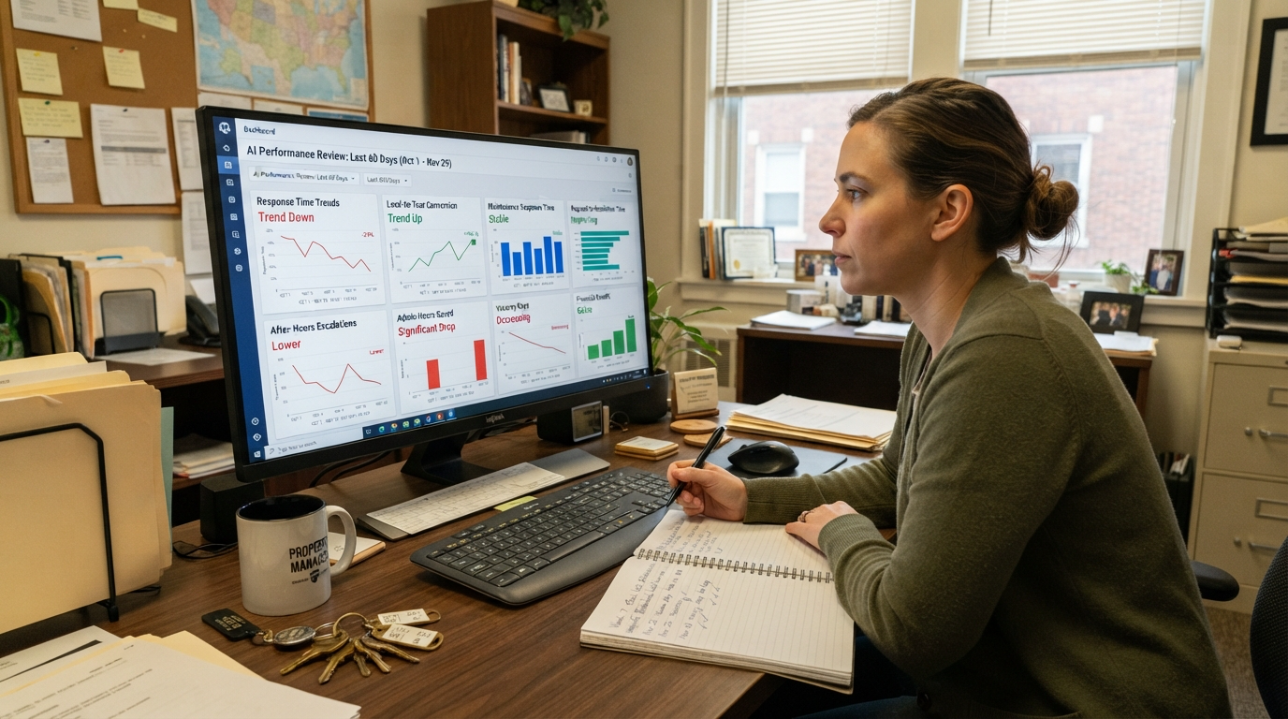
Before implementing AI, record your baseline for at least 30 days. Then track the same metrics after implementation.
KPI | Baseline | Day 30 | Day 60 | Target |
|---|---|---|---|---|
Average response time | ___ | ___ | ___ | ↓ |
Leads responded to | ___% | ___% | ___% | ↑ |
Lead-to-tour conversion | ___% | ___% | ___% | ↑ |
Maintenance response time | ___ | ___ | ___ | ↓ |
Request-to-resolution time | ___ | ___ | ___ | ↓ |
After-hours escalations | ___ | ___ | ___ | ↓ |
Admin hours/week | ___ | ___ | ___ | ↓ |
Vacancy days | ___ | ___ | ___ | ↓ |
AI cost/month | ___ | ___ | ___ | — |
Measurable financial benefit | ___ | ___ | ___ | ↑ |
Do not judge an AI implementation from one metric. A tool can fail to reduce labor costs while still producing meaningful value through faster response times, higher lead conversion, fewer interruptions, or better service consistency.
Where to Start: A Practical Sequencing Framework
Based on the data across every AI success story for small operators reviewed in this piece, here’s the recommended sequence:
Month 1-3: Pick your highest-pain workflow.
If you’re drowning in after-hours maintenance calls, start with maintenance AI. If your vacancy rates are too high and leads go cold, start with leasing AI. Don’t try both simultaneously.
Month 2-3: Measure relentlessly.
Track the specific metrics that matter for your workflow: response time, work orders created, leads captured, tours booked. Compare to your pre-AI baseline. Individual components should show positive ROI within 60 to 90 days.
Month 4-6: Expand to your second workflow.
Once your first workflow is stable and producing measurable results, add the second. By now your team understands how AI fits into daily operations, and onboarding is faster.
Month 6+: Optimize and scale.
Review AI performance data to refine triage rules, response scripts, and vendor routing. Consider expanding to additional properties or workflows (rent collection, lease renewals, vendor management).
This sequencing isn’t theory. It’s the pattern behind every convincing AI success story at the small-operator level. The operators who skip steps or try to compress this timeline are the ones who end up in the 78% who don’t trust their AI tools.
Frequently Asked Questions
How long does it take for a small operator to see ROI from AI?
Individual workflows like leasing and maintenance automation typically show positive ROI within 60 to 90 days. Full break-even across a multi-workflow deployment takes 8 to 11 months for portfolios under 100 units. Larger small operators (150 to 350 units) often hit break-even faster because the per-unit cost of AI decreases while the volume of automated tasks increases.
What’s the minimum portfolio size where AI makes financial sense?
Break-even versus a part-time human assistant occurs at approximately 15 to 30 units. Below 15 units, the value is more about quality of life (reclaiming evenings) than financial return. Above 30 units, the financial case becomes clear, particularly for after-hours maintenance triage and leasing response.
Will AI replace my property management staff?
No. The data consistently shows the opposite. 34% of AI adopters are increasing headcount compared to 25% of non-adopters. AI handles repetitive operational tasks so your team can focus on owner relations, property inspections, and portfolio growth. The small-operator AI success stories that matter involve reallocation of human effort, not elimination.
Should I start with leasing AI or maintenance AI?
Start with whichever pain point is costing you more right now. If you’re losing leads because nobody answers the phone after 5 PM, start with leasing. If emergency maintenance calls are disrupting your nights and weekends, start with maintenance. Both show 60 to 90 day payback periods, so the sequencing matters less than picking one and committing.
Can AI work with my existing property management software?
Most purpose-built AI tools integrate with major PMS platforms like AppFolio and Buildium. The key question is whether the integration supports read-and-write access (AI can create work orders and update records) versus read-only access (AI can see data but can’t take actions). Write access is what separates tools that work from tools that merely assist.
Why do 78% of property managers not trust AI features in their PMS?
Because most native PMS AI features are general-purpose add-ons rather than purpose-built solutions for specific workflows. They tend to be shallow, covering many functions poorly rather than doing one or two things well. Purpose-built AI tools designed specifically for maintenance triage or leasing automation typically outperform native PMS features because they’re trained on property-management-specific scenarios and integrated deeply into those specific workflows.
What does a realistic AI success story look like at 200 units?
A 200-unit operator should expect: maintenance response times dropping from days to hours, 15 to 25 hours per week of admin time reclaimed across the team, 50%+ more after-hours leads captured, and measurable reductions in vacancy duration. Annual savings typically range from $18,000 to $30,000 when combining time savings, faster fills, and reduced emergency repair costs. That’s not transformational on its own, but it compounds as you layer additional workflows and grow your portfolio.